Appears In
Quick Facts
| Role | MAIN |
| Series | Berserk |
| Height | 15 cm |
| Gender | Male |
| Weight | 20 g |
| Hair Color | Light brown |
| Affiliation | Guts' Traveling Party |
| Debut | "The Black Swordsman" |
| Homeland | Elfhelm |
Contents
Background
Background
Puck originates from Elfhelm, the island homeland of elves located on Skellig. The manga reveals relatively little about his earliest life there, but he eventually leaves the island and spends years wandering through the human world. His long absence means that the cultures, prejudices and violence of humans are already familiar to him before he encounters Guts.
Unlike many humans, Puck naturally perceives the astral beings and supernatural disturbances that coexist with the physical world. His status as an elf means the boundary between ordinary reality and the astral realm is never an abstract subject for him; spirits, demons and magical phenomena are aspects of the world he has always understood to exist.
His wandering eventually brings him to the town controlled by Koka Castle's Baron and his men. Puck is captured and abused by human thugs, establishing immediately that his playful nature does not protect him from the cruelty prevalent throughout the setting.
Guts enters the same town while pursuing information about apostles. Their first encounter is hostile in everything but name: Guts rescues Puck largely as a consequence of his own actions against the soldiers and then repeatedly tells the elf to leave him alone.
Puck refuses. He is disturbed by Guts' brutality and fascinated by the emotional contradictions beneath it, particularly the way Guts behaves as though innocent people mean nothing to him while repeatedly taking actions that suggest otherwise.
During the confrontation with the Snake Baron, Puck becomes directly involved in Guts' hunt for apostles. His healing abilities quickly prove valuable, while his ability to sense emotions gives readers access to aspects of Guts that the swordsman refuses to articulate.
Puck remains beside him through subsequent Black Swordsman conflicts, including the encounter with Theresia and The Count. By the time the story moves beyond Guts' solitary revenge journey, Puck has become his most persistent companion.
Personality
Personality
Puck is cheerful, expressive and highly social. He reacts openly to fear, excitement, anger and sympathy rather than suppressing emotion, placing him in direct opposition to Guts' tendency to bury almost everything behind aggression.
He is strongly compassionate. Puck does not divide suffering into categories of people who deserve attention and those who do not, and he repeatedly objects when Guts appears willing to endanger civilians or manipulate vulnerable people to reach an apostle.
That compassion does not make him naïve about human cruelty. Puck has traveled widely before meeting Guts and knows that ordinary people can be violent, selfish or prejudiced. What distinguishes him is his refusal to treat those realities as reasons to become equally cruel.
Puck possesses an unusual sensitivity to emotional states. As an elf, he can perceive powerful feelings and often recognizes fear, grief or hostility before someone expresses it openly. This ability becomes particularly useful around Guts, whose words frequently contradict what Puck senses from him.
His humor becomes increasingly prominent as the manga develops. Puck creates exaggerated personas, performs visual parodies and reacts theatrically to serious situations, especially after Isidro joins the group. These moments do not erase his more serious early characterization; they emerge after Guts is no longer traveling almost entirely alone.
Puck is also stubborn. Guts repeatedly orders him away during their early travels, but Puck follows anyway. His persistence is less about seeking adventure than refusing to abandon someone he recognizes as emotionally damaged and dangerously isolated.
He can become possessive of his place in the group in a lighthearted way, particularly as new magical companions reduce his unique role as the party's interpreter of supernatural phenomena. His friendship with Isidro gives him an eager partner for jokes that the more serious members of the party often find irritating.
Appearance
Appearance
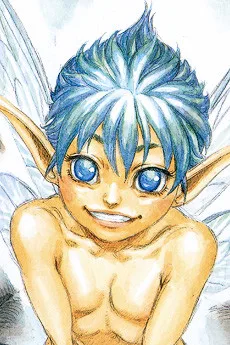
Puck is an extremely small humanoid elf. The Berserk Official Guidebook lists his height at approximately 15 cm and his weight at only 20 grams; his age is left unknown rather than estimated.
He has a childlike face, pointed ears and light-colored hair. His body is proportioned like a miniature human rather than resembling the monstrous astral creatures Guts frequently encounters.
A pair of translucent insect-like wings extends from his back, allowing him to fly freely. This makes ordinary terrain largely irrelevant to his movement and lets him remain near Guts during battles without needing to keep pace on foot.
Puck normally wears minimal clothing suited to his tiny body. His appearance evokes the traditional European conception of a fairy or elf more directly than the darker supernatural beings common elsewhere in the series.
Kentaro Miura frequently renders Puck in a highly simplified form during comic scenes. This exaggerated version has a rounded body and minimal facial detail and is often called "Chestnut Puck" by readers because the silhouette resembles a chestnut.
The simplified appearance exists primarily for comedy rather than representing a literal transformation. During serious scenes, Puck returns to his more detailed humanoid design without explanation.
Abilities & Powers
Abilities & Powers
Puck is not a combatant on the scale of Guts, Serpico or the apostles, but his abilities are extraordinarily useful for survival. As an elf, he possesses several innate supernatural traits unavailable to ordinary humans.
His most important ability is elf dust healing. Dust produced from his wings can accelerate recovery from wounds, reduce pain and help damaged tissue heal. It does not make Guts invulnerable or instantly restore catastrophic injuries, but it repeatedly allows him to survive the accumulated damage of his battles.
The healing effect becomes particularly important during the Black Swordsman period, when Guts travels without conventional medical support and routinely suffers severe injuries fighting apostles. Puck can begin treating him immediately even in isolated locations.
Puck can fly using his wings and is exceptionally maneuverable at close range. His tiny size makes him difficult to strike deliberately, particularly for human-sized opponents.
He possesses empathic perception, allowing him to sense strong emotional states. Puck repeatedly recognizes sadness, fear, anger and affection that other characters conceal verbally.
His awareness of astral phenomena is also naturally stronger than that of ordinary humans. Spirits and supernatural creatures that humans might initially dismiss or fail to perceive are an ordinary part of Puck's experience.
Puck's presence has a subtler effect on environments dominated by supernatural darkness. Elves are associated with comparatively benign astral energy, and his proximity can provide emotional relief alongside literal healing.
He occasionally uses improvised weapons despite lacking meaningful physical strength. Small objects, needles and miniature equipment can inconvenience human opponents, but his contributions to serious battles usually involve support rather than direct damage.
Puck is unusually resilient for his size. He survives dangerous journeys, violent impacts and proximity to supernatural battles, though this should not be confused with the extreme durability possessed by apostles or heavily trained warriors.
His familiarity with Elfhelm later becomes strategically important because the island represents a destination where Guts' party hopes advanced magical knowledge may help Casca. Puck's homeland is therefore transformed from a piece of personal history into one of the central objectives of the group's journey.
Named Techniques
Named Techniques
Puck does not practice a formal martial art and has few conventional named attacks. His recognizable abilities are innate elven powers or recurring improvised tactics.
Elf Dust Healing uses restorative dust from Puck's wings to accelerate recovery, reduce pain and treat injuries. This is his most important practical contribution during Guts' early travels.
Empathic Perception allows Puck to sense emotional states that may contradict a person's outward behavior.
Flight gives him unrestricted aerial movement on a miniature scale, allowing him to scout, evade attacks and reach injured companions rapidly.
Astral Perception lets Puck perceive supernatural entities and phenomena naturally, without the formal magical training required by human practitioners.
Improvised Projectile Attacks use whatever tiny objects are available to distract or irritate opponents. These attacks rarely decide serious battles but can create openings for stronger allies.
Relationships
Relationships
Guts is Puck's longest and most important human companion. Puck meets Guts during the Black Swordsman period and initially follows him despite repeated demands that he leave. Puck is horrified by Guts' cruelty toward enemies and apparent indifference to bystanders, yet his empathic sensitivity tells him that the aggression conceals enormous pain rather than complete emotional emptiness.
Puck gradually becomes indispensable to Guts during the apostle hunts. His healing dust treats injuries after battles, while his willingness to challenge Guts morally prevents the swordsman from existing entirely inside his own revenge. Guts rarely acknowledges how important the elf has become, but he increasingly protects him without hesitation.
Their relationship changes as Guts acquires more companions. Puck is no longer the only person traveling with Guts, yet his position remains unusual because he knew the Black Swordsman at his most isolated and openly destructive.
Isidro becomes Puck's closest comedic companion. Puck quickly finds someone willing to participate in jokes, schemes and exaggerated performances, while Isidro gains a companion who does not constantly treat him as an inexperienced child. Their friendship often creates a lighter parallel to the more serious relationships among the adults.
Casca becomes central to Guts' journey after he abandons his solitary apostle hunt. Puck's healing abilities and supernatural awareness help protect Casca during the long period when she cannot reliably defend herself.
Farnese first encounters Puck through the supernatural events surrounding Guts. Puck's undeniable existence challenges Farnese's religious understanding of the world, since she had been taught to dismiss or condemn much of what he represents.
Serpico becomes another regular traveling companion after Farnese joins Guts. Puck's overt emotionality contrasts with Serpico's habit of concealing almost every serious reaction behind a mild smile.
Schierke understands Puck's existence more naturally than most human characters. Schierke was raised within a magical tradition that treats elves and other astral beings as part of the natural structure of the world rather than myths.
Ivalera is another elf who travels with the group alongside Schierke. Puck and Ivalera share an astral nature but very different personalities and relationships with their respective human companions.
Theresia meets Puck during the confrontation with the Count. Puck sympathizes with Theresia and tries to protect her from the horrific realities surrounding her family, placing him in direct moral opposition to Guts' initially harsh treatment of the girl.
The Count becomes one of the apostles Puck encounters while traveling with Guts. Puck's concern for Theresia makes the conflict personal despite his inability to fight the Count directly.
Jill forms a particularly strong connection with Puck during the Lost Children storyline. Puck sympathizes with Jill's desire to escape an abusive and frightening human world but recognizes that the supernatural refuge offered to her carries its own terrible dangers.
Rosine is another elf-like figure whose existence contrasts sharply with Puck's. Rosine imitates the image of elves through apostle power, while Puck represents the genuine astral beings on which that fantasy is based.
Skull Knight belongs to supernatural affairs far beyond Puck's ordinary experience. Puck recognizes that the mysterious warrior is not a normal human even when much of his history remains inaccessible.
[Danann is closely associated with Elfhelm and its elven inhabitants. When Puck finally returns to his homeland with Guts' party, the journey reconnects him with the wider magical community from which he had spent years wandering.](#spoiler)
[Isma becomes another member of the party whose existence crosses the boundary between human and astral life. Puck accepts her supernatural nature without the confusion that human characters initially experience.](#spoiler)
Story Role
Story Role
Puck appears in the opening Black Swordsman storyline and therefore belongs to the manga's narrative from its earliest chapters. Before readers know the history of Guts, Griffith or the Band of the Hawk, Puck provides the first persistent external perspective on the protagonist.
His presence is structurally important because the opening Guts is deliberately difficult to sympathize with. He threatens people, uses others as bait and speaks about weakness with contempt. Puck repeatedly objects, forcing the story to distinguish between what Guts claims to believe and what his actions eventually reveal.
The Count storyline develops this role further. Puck's compassion toward Theresia opposes Guts' harshness, while his ability to sense emotion reveals that Guts is not as indifferent to suffering as he pretends.
The Golden Age flashback temporarily removes Puck from the narrative because it takes place before Guts meets him. When the story returns to the post-Eclipse timeline, Puck's established presence helps emphasize just how different Guts has become from the young mercenary readers have now seen.
During the Lost Children storyline, Puck becomes particularly relevant because the conflict revolves around creatures presenting themselves as elves. He understands immediately that Rosine's followers are not ordinary elves and becomes closely involved with Jill.
As the Conviction Arc expands the cast, Puck's exclusive position beside Guts begins changing. Farnese, Serpico and Isidro eventually join the journey, meaning the Black Swordsman no longer has only one companion capable of challenging his behavior.
Schierke's arrival changes Puck's narrative function again. She possesses far greater formal knowledge of the astral world, so Puck no longer needs to serve as the primary explanation for every supernatural phenomenon.
Instead, his friendship with Isidro increasingly emphasizes humor and companionship. Puck remains capable of serious intervention, but the growth of the group allows him to behave more freely because Guts no longer depends exclusively on him for emotional and supernatural support.
The revelation that Puck comes from Elfhelm also gives him a direct connection to the party's long-term destination. The supposedly carefree wandering elf turns out to originate from the very place where Guts hopes to find help for Casca.
The voyage eventually brings Puck back to Elfhelm after a long absence. His return occurs as part of a much larger quest than anything that originally motivated him to leave, connecting his personal origin to Casca's recovery and the magical community surrounding the island.
The later destruction of Elfhelm fundamentally alters that connection. The refuge associated with Puck's homeland is lost amid the larger supernatural upheaval, and many astral beings connected to the island disappear from the physical world.
Character Development
Character Development
Puck begins as a wandering observer with little reason to remain attached to any one human. Meeting Guts changes that almost immediately because the contradiction between the swordsman's behavior and emotions becomes something Puck cannot ignore.
During the Black Swordsman period, Puck repeatedly acts as Guts' moral counterweight. He refuses to accept the idea that suffering makes cruelty inevitable and challenges the assumptions Guts uses to justify keeping everyone at a distance.
The relationship affects Puck as well. Guts exposes him to forms of violence far beyond the ordinary dangers of wandering among humans. Puck learns that compassion does not guarantee an ability to save everyone and that some supernatural threats cannot be persuaded or healed.
Jill's storyline demonstrates this tension particularly clearly. Puck understands why an abused child might want to escape humanity entirely, yet he also recognizes that abandoning the human world for Rosine's false elf paradise will not solve the underlying suffering.
As the traveling party expands, Puck becomes less solely responsible for keeping Guts connected to other people. That apparent reduction in seriousness actually reflects Guts' development: Puck can spend more time joking with Isidro because Guts now has Casca, Farnese, Serpico and eventually Schierke around him.
His friendship with Isidro also gives Puck a relationship less defined by caretaking. Isidro can actively participate in his jokes and adventures, allowing Puck to behave as a companion rather than perpetually functioning as the conscience of a traumatized adult.
Schierke's arrival similarly removes the burden of being the group's main supernatural intermediary. Puck's knowledge is intuitive and experiential, whereas Schierke possesses formal magical education. The two roles complement rather than duplicate one another.
Returning to Elfhelm gives Puck an unusual reversal of perspective. For years he is the supernatural outsider accompanying humans; on the island, Guts and the others become visitors to a world much closer to Puck's own origins.
The later loss of Elfhelm places greater weight on his earlier wandering. Puck can no longer regard the island simply as a distant home waiting unchanged somewhere beyond the group's current troubles. Like several of Guts' companions, he is forced to continue without the refuge that once represented a possible endpoint to the journey.
Etymology
Etymology
The name Puck comes from European and particularly English folklore, where a puck is a mischievous fairy, sprite or household spirit. The term has deep roots in Germanic folklore and is associated with supernatural beings capable of playful tricks.
The best-known literary Puck is Puck from William Shakespeare's A Midsummer Night's Dream, also known as Robin Goodfellow. That character is a mischievous fairy servant whose humor and supernatural interference strongly shaped the later cultural image of the name.
Kentaro Miura's Puck shares several broad characteristics with this tradition: tiny stature, wings, supernatural abilities, mischief and a tendency to inject humor into otherwise serious events.
The Japanese name is written パック (Pakku), corresponding directly to the established name Puck rather than representing a separate Japanese word.
The choice also distinguishes Puck from the darker terminology surrounding apostles, demons and the God Hand. His name evokes an older tradition of playful fairy folklore rather than supernatural horror.
Trivia
Trivia
-
The Berserk Official Guidebook gives Puck a height of 15 cm and weight of just 20 grams; his age is explicitly listed as unknown.
-
Puck appears in the very first published storyline of Berserk, making him one of the manga's earliest recurring characters.
-
His healing dust is responsible for treating many of Guts' injuries during the Black Swordsman period.
-
Puck originates from Elfhelm on Skellig, the destination Guts' party later spends years trying to reach.
-
His highly simplified comedy design is commonly called Chestnut Puck because of its rounded, chestnut-like shape.
-
Puck frequently parodies recognizable characters and genres during comedic panels, with these visual jokes existing outside the otherwise serious presentation of the surrounding scene.
-
His friendship with Isidro dramatically increases the amount of visual comedy associated with both characters after the Conviction Arc.
-
Puck's age remains genuinely unpublished rather than being safely inferable from his appearance; elves in Berserk do not follow ordinary human aging assumptions.
In Other Media
In Other Media
Puck is notably absent from the main narrative of the 1997 television adaptation of Berserk. That series concentrates overwhelmingly on the Golden Age, a period taking place before Puck meets Guts, and its framing material does not reproduce his full Black Swordsman role.
The Berserk: The Golden Age Arc film trilogy likewise focuses on Guts' years with the Band of the Hawk and therefore does not give Puck a significant role. The same remains true of Golden Age Arc – Memorial Edition, which expands the films but retains their historical focus.
Puck appears substantially in the 2016–2017 television anime, which adapts post-Golden Age material beginning around the Conviction Arc. The adaptation therefore depicts him as an established companion of Guts rather than recreating their original meeting from the manga.
The television version includes his interactions with Isidro and the expanding traveling party, along with his healing abilities and increasingly comedic behavior. Because the adaptation begins well after Puck's manga debut, viewers relying only on this anime receive substantially less of the early relationship between Puck and Guts.
The released television anime does not reach the completion of the voyage to Elfhelm. Puck's return to his homeland and subsequent manga developments therefore remain unadapted in the major screen versions.
Puck appears prominently in Sword of the Berserk: Guts' Rage for the Dreamcast. The game's original storyline takes place during Guts' travels with Puck and Casca, giving the elf a substantial supporting role.
He also appears in Berserk: Millennium Falcon Hen Seima Senki no Shō for PlayStation 2 and in Berserk and the Band of the Hawk. Game adaptations generally emphasize his role as Guts' companion and healer rather than treating him as a conventional frontline fighter.
Reception
Reception
Puck occupies an unusual position in Berserk because he is present before most of the series' famous historical context has been revealed. Readers first encounter Guts through a world in which Puck is already nearby, while Griffith, Casca and the Band of the Hawk initially exist only as unexplained pieces of the swordsman's past.
That makes Puck particularly important to the Black Swordsman Arc. Without him, Guts' behavior could be taken entirely at face value. Puck senses emotions the protagonist refuses to express and repeatedly identifies the gap between his claims of indifference and his actual reactions.
His healing ability also solves a practical narrative problem without removing consequences from combat. Guts can survive extraordinary injuries between encounters, but Puck's dust does not simply reset his body; accumulated wounds, exhaustion and permanent damage continue to matter.
Puck's later transition toward comedy has produced a noticeably different role. As more companions capable of challenging Guts emotionally enter the party, Puck increasingly appears in simplified form and shares comedic sequences with Isidro. The shift corresponds with the broader change from Guts' solitary Black Swordsman journey to an ensemble traveling party.
His design is especially effective in contrast with the rest of the series. A fifteen-centimeter fairy with delicate wings moves through battlefields filled with mutilation, religious persecution, apostles and enormous weapons, making him visually incompatible with the brutality around him in a deliberate way.
That contrast also preserves a conception of the supernatural that is not inherently horrifying. Guts' earliest experiences with the astral world after the Eclipse are dominated by hostile spirits and apostles, whereas Puck demonstrates from the opening chapters that supernatural existence can also be compassionate, playful and restorative.
His eventual return to Elfhelm adds retrospective importance to a character who initially seems simply to be a wandering fairy. The homeland Puck casually left becomes the destination around which years of Guts' journey are organized, linking one of the manga's oldest supporting characters directly to Casca's long-awaited chance for recovery.
The loss of that refuge then gives Puck a stake in the later story beyond comic relief or healing. Elfhelm is not merely another destroyed location for him; it is the magical homeland from which his entire journey began, leaving him among the many members of Guts' party who must continue forward after discovering that returning home cannot restore the world they once knew.
Related Characters
 SUPPORTING
Theresia
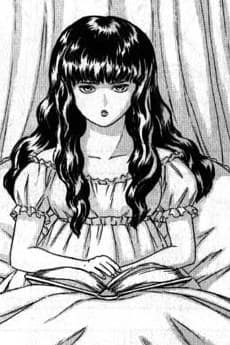
BerserkTheresia is introduced as the Count's daughter, much to Puck's shock, as the elf is given to her as a gift. She appears stiff and stoic around her father, and recoils when he attem
 MAIN
MAINIsidro
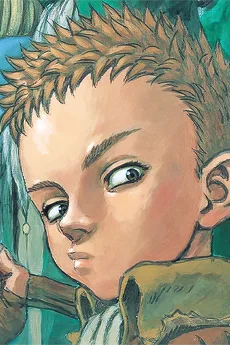
BerserkA runaway brat turned thief, Isidro dreams of becoming a great swordsman, which made him tag along with Guts. Despite his lack of strength and skill, he utilizes his small size and
 MAIN
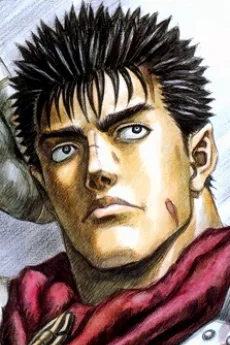
MAINGuts
BerserkGuts is the protagonist of Berserk. He is a tall, muscular man that swings a huge sword called the Dragon Slayer, he has a prosthetic left forearm that has a magnetic grip that als
 MAIN
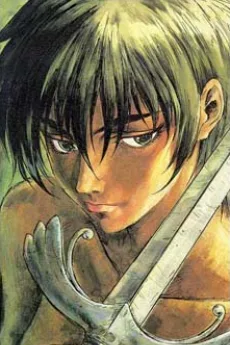
MAINCasca
BerserkCasca was the only female soldier in the original Band of the Hawk and is behind only to Guts and Griffith in swordsmanship. Her ambivalent relationship to both of them makes her m
 MAIN
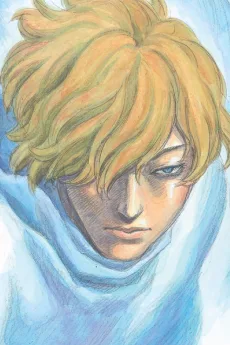
MAINSerpico
BerserkSerpico is Farnese's companion and unbeknownst to her, her paternal half-brother. During his time with the Holy See, Serpico was Herald for the Holy Iron Chain Knights. When aggres
 MAIN
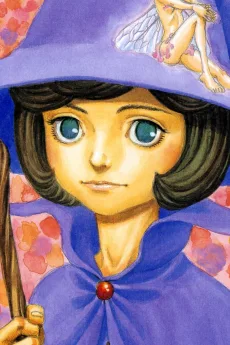
MAINSchierke
BerserkSchierke is a young witch-in-training, a disciple of the witch Flora. She is accompanied by an elf, Evarella. She aided Guts's group with a troll infestation in the nearby village
 SUPPORTING
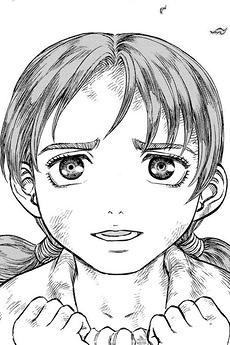
Jill
BerserkJill is a quiet, sensitive girl who lives in a village (which at the time that Guts and Puck arrive) is being plagued by violent attacks from fairies. Her father, Mr. Zepek, is a r
 SUPPORTING
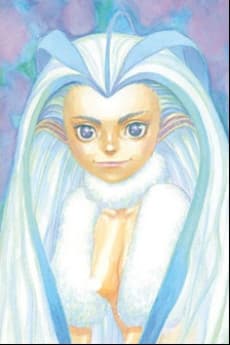
Rosine
BerserkRosine is a female apostle who sacrificed her parents to obtain the form of a female elf with the wings and antennae of a luna moth, as well as a small pair of moth-like limbs near
 SUPPORTING
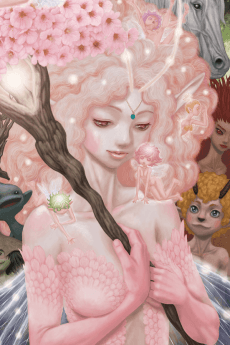
Danann
BerserkThe Flower Storm Monarch (real name Danan) is the lord of the elves, ruling over Elfhelm on the island of Skellig.
 SUPPORTING
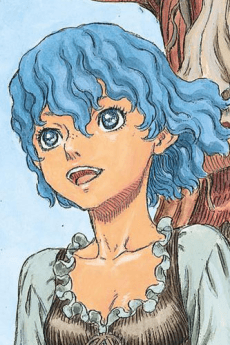
Isma
BerserkIsma is a young fishing girl who lives by the outskirts of the village on an island that holds the Sea God. Isma has short hair with long bangs that will cover half her face at tim