Appears In
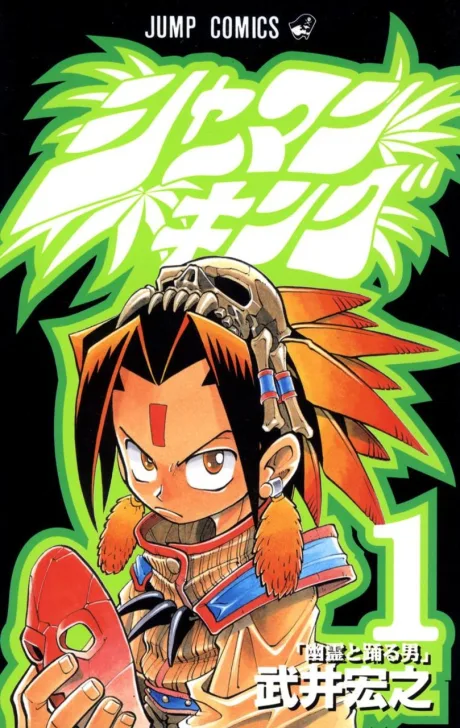
Quick Facts
| Gender | Male |
| Role | MAIN |
| Series | Shaman King |
| Age at Death | 24 |
| Birthday | January 6, 1385 |
| Blood Type | A |
| Gender | Male |
| Zodiac | Capricorn |
| Voice Actor (JP) | Katsuyuki Konishi |
| Voice Actor (EN) | Kaiji Tang |
| Favorite Food | White rice |
| Affiliation | Yoh Asakura; Team Funbari Onsen |
| Aliases | Fiend Amidamaru |
| Debut | Chapter 1, "The Boy Who Dances with Ghosts" |
Contents
Background
Background
Amidamaru is born in Japan in 1385, during a violent period in which bandits and armed conflict are ordinary threats to the poor. As a child, he lives among other impoverished children and learns swordsmanship because survival requires someone capable of defending the group. His fighting ability develops under circumstances very different from formal samurai education: he learns because people around him will otherwise be killed.
His closest childhood friend is Mosuke, a young blacksmith. Amidamaru repeatedly damages the crude swords available to him because the weapons cannot withstand his increasingly powerful technique, forcing Mosuke to repair or replace them despite their lack of good metal. Their skills grow together: Amidamaru becomes the swordsman, while Mosuke becomes the craftsman capable of producing weapons worthy of him.
Mosuke eventually forges Harusame, the sword most closely associated with Amidamaru. According to the surviving account of their youth, the steel needed for the weapon is so difficult to obtain that Mosuke sacrifices a knife inherited from his father to provide the material. Harusame therefore carries personal significance far beyond its practical value as a katana.
As an adult, Amidamaru develops a fearsome reputation. He becomes known as a murderous swordsman whose ability allows him to cut down large numbers of armed opponents, earning the epithet commonly translated as "Fiend Amidamaru." The legend that survives after his death emphasizes the people he killed rather than the circumstances that shaped him, leaving later generations with the image of a bloodthirsty monster.
The reality is more complicated. Amidamaru's violence is closely tied to protecting those around him and surviving a world in which strength determines whether vulnerable people live. His loyalty to Mosuke remains particularly important as he grows older.
Amidamaru is eventually ordered to kill Mosuke. He refuses to murder his closest friend, putting their bond above the authority demanding the execution. The refusal makes Amidamaru himself a target.
Mosuke attempts to forge a final sword, the Sword of Light, for Amidamaru before the confrontation that will decide his fate. Amidamaru intends to meet Mosuke at Funbari Hill to receive it, but soldiers attack before the two can reunite. Amidamaru fights alone and kills many of them before being overwhelmed and killed at the age of twenty-four.
Because Amidamaru dies waiting for Mosuke, his attachment to that promise prevents him from passing on. He remains at Funbari Hill as a bound spirit for approximately six centuries, while stories of the murderous "Fiend Amidamaru" continue to circulate among the living.
His long isolation ends when Yoh encounters him. Yoh does not approach Amidamaru as a dangerous ghost that must be exorcised or controlled; he speaks to him casually and wants to understand why he remains at the cemetery.
The resulting investigation reveals the unfinished promise between Amidamaru and Mosuke. Once Yoh helps the two old friends finally reconnect, Amidamaru no longer has the same reason to remain bound to Funbari Hill.
Rather than departing immediately for the afterlife, however, he chooses a new purpose. He becomes Yoh's guardian ghost and begins fighting beside him, transferring the loyalty that defined his human life into a voluntary partnership with a shaman who treats spirits as equals.
Personality
Personality
Amidamaru is disciplined, formal and deeply loyal. He generally addresses Yoh respectfully as Yoh-dono, reflecting both his samurai upbringing and the seriousness with which he treats their partnership. His speech and conduct contrast strongly with Yoh's relaxed manner.
He possesses a powerful sense of honor, but it is not simple obedience to authority. Amidamaru's history with Mosuke establishes that personal loyalty and moral conviction matter more to him than following an order he believes to be wrong.
That distinction continues after he becomes Yoh's guardian spirit. He willingly follows Yoh because he respects him, not because he considers himself a slave whose role is unconditional submission. Their relationship depends on trust.
Amidamaru is usually restrained in conversation. He does not seek attention and rarely competes socially with the much louder personalities surrounding Yoh.
His seriousness nevertheless allows room for humor. Living around Yoh, Manta Oyamada, Anna Kyoyama and the other shamans gradually places the centuries-old warrior in situations entirely outside anything he experienced while alive.
Amidamaru also possesses considerable humility. His reputation as an invincible killer does not lead him to assume that his swordsmanship makes him superior to every other spirit.
Encounters with increasingly powerful guardian ghosts force him to continue developing. Amidamaru views improvement as part of his duty to Yoh rather than as a way to protect his reputation.
He is especially sensitive to loyalty between friends. His own unfinished promise with Mosuke lasted centuries, making betrayal and abandonment matters he understands differently from someone whose relationships have existed only for a few years.
At the same time, he admires Yoh's capacity for forgiveness. Amidamaru comes from an era where threats were often answered with swords, whereas Yoh repeatedly chooses understanding even when violence would be easier.
The partnership changes Amidamaru as much as it strengthens Yoh. Fighting beside a shaman who does not define victory solely through defeating an opponent gradually broadens the old samurai's understanding of what strength can accomplish.
Appearance
Appearance
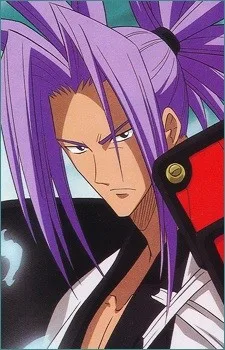
Amidamaru appears as a tall, muscular adult samurai preserved in the form he had near the end of his human life. His spirit retains the clothing, facial features and warrior equipment associated with his historical period.
He has long white hair gathered behind his head, with loose sections framing his face. His strong jaw, pronounced eyebrows and generally serious expression reinforce the veteran-warrior impression created by his physique.
His clothing consists of traditional samurai garments rather than full heavy battlefield armor. A distinctive shoulder arrangement and loose trousers provide him with the recognizable silhouette seen both in his normal spirit form and when Yoh channels his power.
As a ghost, Amidamaru can also assume the simplified Hitodama Mode commonly used by spirits in Shaman King. In this state, his body compresses into a small floating flame-like spirit form while retaining recognizable facial features.
Hitodama Mode is particularly useful outside combat because a guardian ghost does not need to maintain a human-shaped manifestation constantly. Amidamaru often accompanies Yoh in this smaller state.
When Yoh performs Spirit Integration, Amidamaru himself is not simply standing beside him. His spirit enters Yoh's body, and visual changes communicate the temporary overlap between their personalities and abilities.
When placed into Harusame as an Oversoul, Amidamaru instead forms spiritual energy around the sword. Later Oversouls increase dramatically in scale, making his presence visible as enormous spiritual blades and armored constructs associated with his samurai identity.
Abilities & Powers
Abilities & Powers
Amidamaru's defining strength is his swordsmanship. He spent his human life fighting continuously and developed techniques beyond the capabilities of ordinary warriors.
His style is known as Amidaryū, or the Amidamaru Style. It combines extraordinarily powerful physical cuts with techniques capable of producing effects that appear almost supernatural even before shamanic energy becomes involved.
Amidamaru possesses enough control to turn unconventional objects into lethal weapons. Accounts of his technique describe him as capable of cutting effectively even with wooden swords or grave markers, demonstrating that his lethality depends heavily on technique rather than solely on blade quality.
As a spirit, he retains the knowledge and muscle memory accumulated during life. When Yoh performs Spirit Integration, that experience becomes available through Yoh's body.
The result is not merely a strength increase. Yoh gains access to Amidamaru's timing, sword angles, defensive reactions and battlefield instincts.
This is particularly important early in the story because Yoh himself has not spent decades mastering swordsmanship. Through Amidamaru, he can immediately fight opponents who would otherwise possess an overwhelming technical advantage.
Amidamaru later functions as the spirit core of Yoh's Oversoul. Instead of inhabiting Yoh directly, he is placed into Harusame so that Yoh's furyoku can give the spirit physical form around the weapon.
The quality of an Oversoul depends partly on the relationship between shaman and spirit. Yoh and Amidamaru's unusually cooperative bond therefore becomes a major advantage.
Their synchronization improves repeatedly during the Shaman Fight. Yoh learns Amidamaru's sword techniques well enough that the distinction between the spirit's skill and the shaman's own combat instincts gradually becomes less absolute.
Amidamaru himself also evolves. Guardian spirits in the series are not static collections of abilities; experience and spiritual development can change their nature.
Through Yoh's later training and the accumulation of spiritual power, Amidamaru eventually rises into the category of a Seirei-class spirit. His spiritual form becomes substantially more powerful than the wandering ghost Yoh originally met at Funbari Hill.
His evolved condition supports Yoh's more advanced Oversouls, including the Spirit of Sword, allowing the partnership to remain viable even after the Shaman Fight reaches levels far beyond ordinary human sword combat.
Named Techniques
Named Techniques
Amidaryū is Amidamaru's personal school of swordsmanship. It encompasses the techniques he developed during his human life and later passes to Yoh through Spirit Integration.
Shinkū Buddha-Giri creates an exceptionally powerful cutting attack capable of extending beyond the immediate reach of the blade. The technique is commonly rendered as Vacuum Buddha Slash or a similar translation.
Gokōjin is a rapid sword attack launched from the distinctive Nyorai stance. Amidamaru partially draws his blades from the scabbards at his waist before delivering an extremely fast cut.
Nyorai is the preparatory stance associated with Gokōjin. The posture places Amidamaru in position to draw and strike with exceptional speed.
Spirit Integration: Amidamaru is performed by Yoh rather than Amidamaru alone, but it relies directly on Amidamaru entering Yoh's body. Their consciousness and combat abilities overlap, allowing Yoh to reproduce Amidaryū swordsmanship.
Oversoul: Amidamaru in Harusame places Amidamaru inside his former sword. Yoh's furyoku then manifests the spirit around the katana as an enlarged spiritual blade.
Double Medium Oversoul uses both Harusame and the Futsu-no-Mitama no Tsurugi to support a larger manifestation of Amidamaru.
Spirit of Sword is the advanced Oversoul built around Amidamaru and Yoh's two sword mediums. It represents the highest development of their normal shaman-and-guardian-spirit partnership before Yoh begins using elemental-class spirits.
Relationships
Relationships
Yoh Asakura is Amidamaru's shaman, closest modern companion and the person to whom he entrusts his swordsmanship. Amidamaru initially meets Yoh Asakura while still bound to Funbari Hill by his promise to Mosuke.
Rather than attempting to control him, Yoh Asakura treats Amidamaru as someone whose unfinished business deserves to be understood. That approach immediately distinguishes Yoh from people who view spirits primarily as sources of supernatural power.
Once his promise is resolved, Amidamaru voluntarily becomes Yoh Asakura's guardian ghost. His frequent use of "Yoh-dono" communicates formal loyalty, but their relationship gradually becomes closer to friendship than master and retainer.
Yoh Asakura entrusts his body to Amidamaru during Spirit Integration, while Amidamaru places his spiritual existence in Yoh's hands during Oversoul. That mutual dependence requires unusually strong trust.
The relationship also allows both to grow. Amidamaru provides combat experience, while Yoh Asakura gives Amidamaru a view of strength based less on killing opponents and more on understanding them.
Mosuke is Amidamaru's oldest and most important human friend. Amidamaru and Mosuke grow up together in poverty, with one developing into a swordsman and the other into a blacksmith.
Mosuke repeatedly supplies Amidamaru with weapons despite the limited materials available to them. Harusame becomes the greatest surviving symbol of their friendship.
[When Amidamaru is ordered to kill Mosuke, he refuses. The choice turns him against the people issuing the order and contributes directly to the confrontation that results in his death.](#spoiler)
[Mosuke attempts to forge one final weapon for Amidamaru, but the two cannot meet before Amidamaru is killed. Their failure to reunite keeps Amidamaru attached to Funbari Hill for centuries.](#spoiler)
Yoh Asakura eventually enables Amidamaru and Mosuke to fulfill the promise emotionally, freeing Amidamaru from the resentment and regret connected to the meeting that never happened.
Manta Oyamada becomes one of Amidamaru's first modern acquaintances. Manta Oyamada's ability to see spirits allows him to interact directly with Amidamaru despite not being a practicing shaman.
Amidamaru's existence helps Manta Oyamada understand Yoh's claim that ghosts are not necessarily frightening. The feared "Fiend Amidamaru" turns out to be far more honorable than the stories surrounding his name.
Anna Kyoyama becomes another constant presence around Yoh. Amidamaru respects Anna Kyoyama's spiritual strength and accepts her authority within Yoh's household, even when her training regimens are extreme.
Like Yoh, Anna Kyoyama possesses a relationship with spirits based on direct spiritual perception rather than superstition. Her ability to summon and control spirits places her among the humans capable of understanding Amidamaru's nature without needing explanation.
Tokageroh has a far more hostile connection to Amidamaru's human past. Tokageroh retains a grievance against Amidamaru stemming from the violence associated with Amidamaru's life as a samurai.
Centuries later, Tokageroh possesses Ryunosuke Umemiya and attacks Yoh's group in an attempt to take revenge. The official 2021 anime describes Tokageroh specifically as an evil spirit bearing a grudge against Amidamaru.
Yoh Asakura's response ultimately prevents the conflict from becoming another cycle of revenge. Amidamaru does not need to destroy Tokageroh permanently to resolve the hatred between them.
Ryunosuke Umemiya first crosses Amidamaru's path as the delinquent known as Wooden Sword Ryu. Amidamaru's power is initially used by Yoh Asakura to defeat Ryu after his gang causes trouble for Manta. The official anime's opening episode establishes this confrontation as Yoh's first major use of Amidamaru's strength.
Later, Ryunosuke Umemiya becomes a shaman and ally rather than an enemy. His guardian ghost being Tokageroh makes the relationship particularly notable: two spirits connected by ancient hostility eventually fight on the same broader side.
Bason is Ren Tao's warrior spirit and serves as one of Amidamaru's earliest major guardian-spirit counterparts. Both are ancient warriors whose fighting expertise gives their shamans access to martial techniques impossible for ordinary teenagers.
Unlike Amidamaru's cooperative relationship with Yoh, Bason's early partnership with Ren Tao reflects Ren's original belief that spirits exist to serve their masters. The contrast reinforces the ideological difference between Yoh and Ren.
As Ren changes, that distinction narrows. Amidamaru and Bason eventually stand among the guardian spirits of allied shamans rather than enemies competing for dominance.
Hao Asakura represents a threat operating on a spiritual scale far beyond the opponents Amidamaru knew during life. Amidamaru supports Yoh throughout the conflict with Hao Asakura, even as the difference between an ordinary human ghost and Hao's enormous spiritual resources becomes increasingly pronounced.
Rather than being replaced immediately when more powerful spirits become available, Amidamaru remains emotionally central to Yoh. Their bond has value independent of numerical furyoku.
[Even when Yoh Asakura eventually receives the Spirit of Earth, Amidamaru remains his defining guardian spirit and continues beyond the original Shaman Fight as part of the Asakura family's story.](#spoiler)
Hana Asakura becomes important to Amidamaru after the events of the original series.
[In the sequel era, Amidamaru serves as a guardian spirit to Hana Asakura, the son of Yoh and Anna. This carries his connection with the Asakura family into the next generation.](#spoiler)
Story Role
Story Role
Amidamaru appears at the beginning of the story as the supposedly terrifying ghost haunting Funbari Hill. His reputation allows the series to immediately challenge the assumption that a violent legend accurately describes the person behind it.
Yoh's willingness to speak with him rather than fear him establishes one of Shaman King's central ideas: spirits retain personality, memories and relationships after death.
Amidamaru's unresolved connection to Mosuke then provides the first substantial demonstration of Yoh's abilities as a shaman. Yoh does not merely command ghosts; he can help the dead communicate with the living and resolve attachments that have persisted for centuries.
Once Amidamaru becomes Yoh's guardian spirit, he provides the combat ability necessary for the story to move from spiritual encounters into shaman battles.
The confrontation with Ryu demonstrates Spirit Integration, while later opponents show why borrowing a warrior's experience can be more important than simply possessing supernatural power.
When Jun Tao attempts to take Amidamaru for Ren, his value as a guardian spirit becomes explicit. The official anime describes Jun approaching Yoh specifically because she intends to steal Amidamaru for her younger brother.
The Shaman Fight qualification test changes Amidamaru's role again. Yoh learns Oversoul, meaning Amidamaru no longer needs to possess Yoh directly in order to fight.
Harusame becomes the physical medium linking them. The sword's connection to Mosuke means Yoh's new combat system is built literally around the friendship that defined Amidamaru's human life.
Throughout the tournament, Amidamaru remains Yoh's primary combat spirit even as opponents begin using gods, demons, angels and other extremely powerful supernatural beings.
That persistence matters because Yoh's progress is not built around discarding old partners whenever a stronger one becomes available. Instead, Yoh and Amidamaru repeatedly increase what they can accomplish together.
The Futsu-no-Mitama no Tsurugi expands their possibilities further, enabling larger Oversouls and eventually the Spirit of Sword.
Amidamaru's spiritual class rises as the tournament reaches its later stages, allowing him to remain relevant alongside increasingly powerful guardian spirits.
During the conflict surrounding Hao's ascent, Amidamaru accompanies Yoh through battles against the Patch officiants protecting the route to the Great Spirit. The partnership that begins with a local cemetery ghost therefore continues into a confrontation concerning the future of humanity itself.
After the original Shaman Fight, Amidamaru's story extends into the next generation. He eventually accompanies Hana Asakura, preserving the link between the old samurai and the family of the shaman who freed him from Funbari Hill.
Character Development
Character Development
Amidamaru's first defining condition is attachment to the past. For six centuries, he remains physically and emotionally centered on the promise he could not fulfill with Mosuke.
That devotion is admirable, but it also prevents him from moving forward. His loyalty has effectively frozen him at the place where his human life ended.
Yoh changes that situation without asking Amidamaru to forget Mosuke. Instead, he helps complete the emotional meaning of the promise.
This is important to Amidamaru's development because moving forward does not require abandoning the relationship that kept him at Funbari Hill. Harusame itself travels forward with him, turning Mosuke's friendship into part of his new partnership with Yoh.
Amidamaru then begins living, in a spiritual sense, in an era radically different from his own. The Shaman Fight introduces him to warriors and religious traditions from across the world rather than the localized conflicts that shaped his human life.
His identity also changes from feared killer to guardian. The techniques that once produced a legend about a murderous samurai are redirected toward protecting Yoh and the people around him.
The relationship is voluntary. That difference is especially important when compared with shamans who treat spirits as possessions.
Yoh consistently asks for Amidamaru's cooperation rather than assuming ownership. Amidamaru therefore becomes loyal because he chooses loyalty, just as he once chose Mosuke over the authority ordering his death.
His evolution as a spirit mirrors that emotional progression. As Yoh develops, Amidamaru also becomes capable of supporting increasingly sophisticated Oversouls.
His eventual rise into a higher spiritual class demonstrates that death has not made him static. Amidamaru continues learning and changing centuries after his biological life ended.
The continuation into Hana's generation extends that development further. The samurai once unable to move beyond the hill where he died eventually becomes a spirit whose relationships span more than six centuries and multiple generations of the same family.
Etymology
Etymology
The name Amidamaru is written 阿弥陀丸.
Amida refers to Amitābha Buddha, known in Japanese Buddhism as Amida Nyorai. Amitābha is the central Buddha of Pure Land Buddhist traditions, and reference works on the character specifically identify Amidamaru's name as deriving from Amida.
The suffix -maru is a traditional element found in Japanese male names, particularly historical or childhood names, as well as the names of ships and swords.
The Buddhist naming is reflected elsewhere in Amidamaru's swordsmanship. Technique names such as Shinkū Buddha-Giri, Nyorai and Gokōjin draw on Buddhist terminology and imagery.
Nyorai is a Japanese Buddhist title corresponding to tathāgata, an epithet applied to enlightened Buddhas.
The name Harusame is written 春雨, literally "spring rain." The comparatively gentle name contrasts with the weapon's importance to one of the most feared swordsmen of Amidamaru's era.
His historical epithet commonly translated as Fiend Amidamaru reflects the terrifying public reputation produced by his killings rather than the personality Yoh eventually discovers.
Trivia
Trivia
-
Amidamaru was born on January 6, 1385, making him a Capricorn; profile material also gives his blood type as A.
-
He was 24 years old at the time of his death.
-
His favorite food is listed as white rice.
-
He remains at Funbari Hill for approximately 600 years before becoming Yoh's guardian ghost. Both the official anime and later sequel material consistently describe him as a samurai spirit from six centuries earlier.
-
Harusame was forged by his best friend Mosuke, whose status as Amidamaru's closest friend and a blacksmith is confirmed by the official anime production.
-
Katsuyuki Konishi voices Amidamaru in both the 2001 and 2021 Japanese television adaptations. The official 2021 anime retained Konishi in the role.
-
His name derives from Amitābha Buddha, or Amida Buddha in Japanese Pure Land traditions.
-
Amidamaru's relationship with the Asakura family continues beyond Yoh: the sequel era identifies him as the guardian spirit accompanying Yoh's son Hana.
In Other Media
In Other Media
Amidamaru is a major character in the 2001 television adaptation of Shaman King. Katsuyuki Konishi voices him in Japanese, establishing the deep, formal delivery associated with the character's respectful manner toward Yoh.
The 2001 series adapts his initial history with Mosuke, his partnership with Yoh and his development through Spirit Integration and Oversoul before eventually departing from the manga's storyline in significant ways.
Because the first anime develops an original conclusion, Amidamaru's later battles and the ultimate form of Yoh's progression differ substantially from the completed manga continuity.
The 2021 adaptation again casts Katsuyuki Konishi as Amidamaru. The official character page specifically lists Konishi with the character, while the production's promotional material also confirms Mosuke as Amidamaru's great friend from his human life.
The newer adaptation follows the completed manga much more closely. Amidamaru therefore appears through Yoh's full progression from ordinary Spirit Integration to advanced Oversouls and the late Shaman Fight.
He also returns in Shaman King: Flowers. Official material for the sequel describes Amidamaru as the samurai spirit who fought in the Shaman Fight as Yoh's guardian spirit and shows him accompanying Hana Asakura.
Amidamaru has appeared extensively in Shaman King games, usually functioning as the basis for Yoh's attacks rather than as an entirely separate combat system. Spirit Integration, Harusame and later Oversoul forms naturally translate into fighting-game and action-game techniques.
He is also one of the franchise's most frequently merchandised spirits. Figures commonly represent either his full samurai form or the smaller Hitodama form used when he accompanies Yoh outside battle.
Reception
Reception
Amidamaru has remained one of the franchise's defining visual and narrative partners because he establishes the relationship between shamans and spirits at the very beginning of the story. Official 2021 promotional material places him alongside Yoh among the central returning characters, with Katsuyuki Konishi reprising the role from the earlier adaptation.
His introduction also establishes an important recurring pattern within the series: reputation and morality are not always the same thing. The living remember a murderous samurai, while Yoh discovers someone whose violence, loyalty and unfinished promise are considerably more complicated.
Harusame gives that relationship unusual continuity. The sword is not simply equipment Yoh acquires; it is a surviving product of Amidamaru's friendship with Mosuke, connecting Yoh's modern battles directly to the samurai's human life.
The partnership with Yoh also became one of the recognizable examples of the series' guardian-spirit system. Rather than giving its protagonist an abstract elemental power from the beginning, Shaman King ties Yoh's combat ability to another character with his own history, personality and agency.
Amidamaru's samurai design reinforces that concept visually. Yoh remains a contemporary teenager wearing headphones, while the spirit whose abilities he channels belongs to a world six centuries removed from his own.
That contrast persists even as the scale of the story expands. Amidamaru begins as the ghost of a local legend feared around one cemetery, yet his partnership with Yoh eventually carries him into battles involving ancient shamans, divine spirits and the Great Spirit itself.
His later association with Hana gives the character an additional generational dimension. Amidamaru's original story begins because he cannot move beyond a promise from his own lifetime; his later story places him beside the descendants of the person who finally allowed him to move forward.
Related Characters
 MAIN
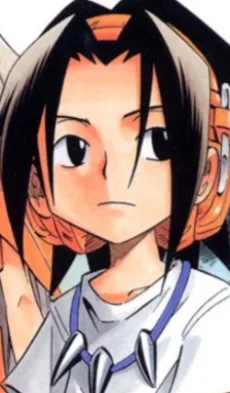
MAINManta Oyamada
Shaman KingAn intelligent but worrisome teen who always carries a "dictionary/encyclopedia/compendium of all human knowledge", and has a sixth sense, meaning he can see supernatural
 MAIN
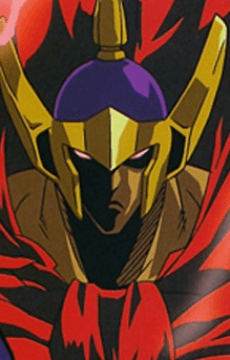
MAINYoh Asakura
Shaman KingYoh was born into the famous Shaman family, Asakura. He has a twin brother named Hao who is a powerful reincarnation of the original HAO who keeps getting reborn. For this reason,
 SUPPORTING
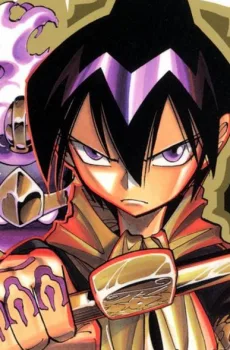
Bason
Shaman KingBason is the ghost of an ancient Chinese wujiang who serves Ren faithfully and obeys him without question. In the English manga Bason calls Ren "Master Ren," while in the
 MAIN
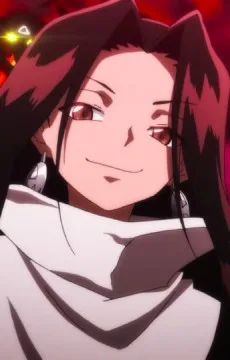
MAINRen Tao
Shaman KingLen is a Shaman from China, one of the few remaining members of the Tao Family, who after their years of serving as the guardians of the Forbidden City, became outcasts and condemn
 MAIN
MAINHao Asakura
Shaman KingAsakura Hao is the main antagonist in Shaman King and the most powerful shaman in the entirety of the series.
 SUPPORTING
Hana Asakura
Shaman KingHe is the six year old son of Yoh Asakura and Anna Kyoyama who is now traveling with Ryu, but is currently in the custody of Tamao Tamamura. He only appears in the special chapter,
 SUPPORTING
Jun Tao
Shaman KingJun is the older sister of Tao Ren. She is a dao-si who can reanimate corpses. Her jiāngshī (guardian zombie, in Japanese, "kyonshii") is Lee Bailong (known as Lee Pai-Long in the