Appears In
Quick Facts
| Gender | Male |
| Role | MAIN |
| Series | Shaman King |
| Height | 145 cm |
| Age | 13 |
| Birthday | January 1, 1986 |
| Blood Type | AB |
| Gender | Male |
| Eye Color | Golden-brown |
| Hair Color | Dark purple |
| Zodiac | Capricorn |
| Voice Actor (JP) | Romi Park |
| Voice Actor (EN) | Laura Stahl |
| Affiliation | Team The Ren |
| Debut | Chapter 5 |
| Guardian Spirit | |
| Father | |
| Mother | |
| Sister | |
| Grandfather |
Contents
Background
Background
Ren is born into the Tao family, a lineage of Chinese shamans that has operated behind the country's history for roughly two thousand years. The family possesses enormous wealth, a private mountain stronghold and generations of accumulated supernatural knowledge. From birth, Ren is expected to inherit not simply the family name but its ideology: power is necessary for survival, enemies must be crushed before they can become threats, and spirits exist to serve shamans rather than stand beside them as equals.
His father, Tao En, oversees much of this conditioning. Ren undergoes severe physical and spiritual training while still a child, producing an exceptionally skilled fighter before he is old enough to enter the Shaman Fight. His older sister, Tao Jun, participates in his upbringing and initially shares the family's assumption that guardian spirits and reanimated corpses are instruments whose personal wishes are irrelevant. Their mother, Tao Ran, and grandfather, Tao Chin, belong to the same broader household, though Ren's conflict with En dominates his understanding of what the Tao name means.
The result is a boy who believes hatred is strength. Ren grows up convinced that humanity is fundamentally corrupt and that becoming Shaman King will allow him to destroy the existing world and replace it with one purified according to his own ideals. Bason, an ancient Chinese warrior who has served the Tao family for centuries, becomes his guardian spirit. Ren respects Bason's combat ability but initially refuses to regard him as a friend, believing emotional attachment would compromise the master's control over his servant.
Ren travels to Japan before the formal Shaman Fight qualifiers and encounters Yoh while seeking a powerful spirit for himself. He takes particular interest in Amidamaru, whose reputation as a legendary samurai makes him more valuable in Ren's eyes than an ordinary ghost. When Yoh refuses to surrender Amidamaru, Ren cannot understand the idea that a spirit might voluntarily choose its shaman rather than exist as property.
Their first battle exposes the weakness in Ren's worldview. Yoh and Amidamaru's synchronization is strengthened by trust, while Ren's relationship with Bason is governed by command. Ren remains the more aggressively trained fighter, but Yoh's connection with Amidamaru allows him to resist techniques Ren expects to be overwhelming. The defeat does not immediately reform Ren; instead, it gives him a rival whose existence contradicts principles he has been taught his entire life.
During the Shaman Fight preliminaries, Ren continues fighting with the objective of proving himself superior to Yoh and everyone else. Their decisive qualifying match becomes less a clash between strangers than a confrontation between incompatible ideas of strength. Ren insists that destroying obstacles is proof of power, while Yoh refuses to accept the premise that strength requires hatred.
After the preliminaries, Ren returns to China and confronts his family. Yoh, Manta, Ryu and Horohoro eventually become involved, turning Ren's personal rebellion against his father into an important turning point. Rather than simply defeating En and replacing him as another authoritarian Tao heir, Ren begins separating himself from the cycle of resentment that produced him.
By the time he reaches the main Shaman Fight, Ren is no longer pursuing exactly the same dream. He still wants to become Shaman King and retains an intense desire to surpass Yoh, but his ambition increasingly centers on proving his own path rather than destroying humanity in obedience to inherited hatred.
Personality
Personality
Ren is proud, impatient and intensely competitive. He dislikes admitting weakness and reacts badly when someone treats him as inferior, particularly when the comparison involves Yoh. His confidence is not empty bravado: the official characterization of Ren emphasizes that behind his pride lies relentless training sufficient to justify much of his self-belief.
He is also quick-tempered. Ren often responds to mockery, incompetence or unnecessary delay with threats or violence, and even close companions learn that irritating him can provoke an immediate attack. His distinctive hair spike frequently appears to exaggerate along with his anger, turning one of his visual trademarks into an extension of his mood.
Early Ren confuses emotional detachment with strength. He believes dependence creates vulnerability and therefore refuses to acknowledge how much Bason, Jun or even his own family matter to him. Yoh's willingness to trust other people is particularly offensive because it challenges the idea that Ren's lonely upbringing was necessary.
That attitude gradually changes without making him gentle. Ren remains abrasive throughout the series, but the object of his pride shifts. He begins caring less about proving that he needs nobody and more about proving that he can protect the people who have chosen to stand beside him.
His friendships frequently take competitive forms. Ren rarely expresses affection through sentimental declarations. Instead, he argues, fights, trains harder and becomes furious when allies endanger themselves unnecessarily. Much of his concern is translated into irritation because direct vulnerability remains difficult for him.
This is particularly visible with Yoh. Ren refuses to treat Yoh as a superior even when acknowledging Yoh's strengths, and their rivalry becomes an important source of motivation. Yoh's refusal to compete according to Ren's terms can frustrate him more than an ordinary defeat because Yoh often seems unconcerned with rankings that Ren has spent his life treating as fundamental.
Ren also possesses a strong sense of responsibility. Once he becomes the leader of Team The Ren, his decisions are no longer solely personal. He increasingly understands that Horohoro and Chocolove McDonell have entrusted their lives and ambitions to the team.
His arrogance can obscure considerable intelligence. Ren studies opponents carefully and has an exceptional ability to reproduce principles he has observed in battle. He does not simply attack harder when confronted with a new technique; he analyzes how it works and looks for a way to incorporate the underlying idea into his own fighting style.
By the later stages of the story, Ren has developed a much stronger moral aversion to killing. This does not erase the consequences of violence committed during his earlier worldview, and the series deliberately forces him to confront those consequences rather than treating his character growth as cancellation of the past.
Appearance
Appearance
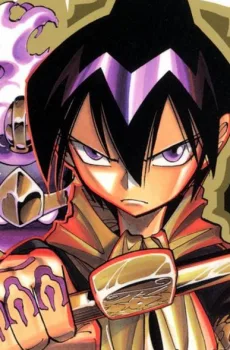
Ren is short for his age, standing approximately 145 cm during the main series. His slight frame contrasts with the enormous guardian-spirit manifestations he eventually commands and with the oversized guandao he handles confidently in close combat.
His most recognizable physical feature is the single long spike of hair extending upward from the top of his head. The rest of his hair is short and dark, typically rendered in shades of purple or nearly black depending on the adaptation. The spike becomes so strongly associated with Ren that official character descriptions single it out as his visual trademark.
Ren's eyes are narrow and severe, usually colored golden or brownish in animation. Combined with his habitual scowl and rigid posture, they reinforce the impression that he is perpetually evaluating whether the person in front of him is worth his time.
His early clothing is based on Chinese-inspired designs. Ren commonly wears a sleeveless dark outfit with decorative trim and loose trousers suited to combat, along with pointed shoes. The clothes preserve his connection to the Tao family's Chinese identity without restricting the acrobatic movements required by his weapon techniques.
He later receives more elaborate battle clothing as his role in the Shaman Fight develops. His tournament designs retain the same broad Chinese visual vocabulary while becoming more closely integrated with the supernatural equipment and Over Souls he acquires.
Ren's primary conventional weapon is a guandao, a long Chinese polearm with a heavy curved blade. The weapon suits both his small stature and aggressive fighting method because its reach allows him to generate sweeping attacks against larger opponents without sacrificing mobility.
A second major weapon is the Tao family heirloom commonly called the Bâo-Lèi Sword, or Thunder Sword. En gives it to Ren after recognizing that his son has become strong enough to choose his own path. The weapon later becomes essential to Ren's strongest lightning-based Over Souls.
Even as his supernatural forms become increasingly elaborate, Ren himself remains visually compact. The contrast between the small thirteen-year-old shaman and the huge forms of Bason becomes part of his combat identity.
Abilities & Powers
Abilities & Powers
Ren is an elite shaman before entering the main tournament. Years of training within the Tao household give him high Furyoku, exceptional physical conditioning and far more practical combat experience than most shamans his age. His reflexes are sharp enough to fight at close range while simultaneously maintaining precise control over Bason.
His guardian spirit Bason was a powerful Chinese military commander in life. Bason is skilled with numerous weapons, particularly the guandao, and possesses experience fighting both on foot and horseback. Ren can use Hyoi Gattai to merge Bason directly with his own body, gaining the warrior's technique and physical instincts.
Ren later develops Over Soul, initially using his guandao as Bason's medium. Instead of merely borrowing Bason's movements, Ren externalizes the spirit through the weapon, allowing the warrior's limbs and equipment to manifest at enormous scale.
Bason is especially suited to battlefield combat against multiple enemies. Where Amidamaru's swordsmanship excels in individual duels, Bason's military background allows Ren to attack wide areas and adapt to formations, mounted combat and multiple simultaneous targets.
Ren is also an accomplished rider. Bason's former warhorse Hei-Tao can combine with Ren's horse Bai-Feng, allowing Ren and Bason to recreate mounted techniques from Bason's lifetime. Their synchronization produces one of the clearest examples of Ren learning to cooperate with his spirit rather than simply commanding him.
His battlefield intelligence is exceptional. During encounters with Mikihisa Asakura, Ren studies techniques used against him and learns principles by observation. This adaptability allows him to close gaps that cannot be overcome merely by increasing raw Furyoku.
Advanced training through the Chō-Senjiryakketsu further raises his abilities. Like several of Yoh's allies, Ren learns methods that radically expand the amount and efficiency of spiritual power he can control.
The Bâo-Lèi Sword gives his fighting style another major evolution. Its connection to thunder makes it a suitable medium for electricity-based Over Souls, allowing Ren to move beyond straightforward manifestations of Bason's human form.
Ren eventually becomes one of the Five Elemental Warriors and receives the Spirit of Thunder, one of the Five Grand Elemental Spirits. The partnership dramatically expands his scale of combat and makes lightning itself the defining element of his highest-level techniques.
Ren's late-series Furyoku rises enormously compared with his starting level. Part of that increase is connected to the series' mechanics surrounding death and revival: crossing the boundary between life and death can dramatically expand a shaman's Furyoku.
Ren undergoes resurrection after receiving a fatal wound during the tournament, leaving him substantially stronger upon his return.
His greatest technical strength, however, remains precision. Ren does not rely solely on enormous spiritual reserves. He combines weapon training, speed, tactical observation and increasingly cooperative synchronization with Bason.
Named Techniques
Named Techniques
Chūka Zanmai is one of Ren's fundamental guandao techniques. He launches a rapid series of thrusts and slashes, using Bason's weapon knowledge to overwhelm an opponent through speed and reach.
Golden Chūka Zanmai strengthens the same principle through spirit integration, producing an intensified flurry of guandao attacks.
Chō Golden Chūka Zanmai is an advanced Over Soul version of Ren's rapid-strike technique. Bason's upper body manifests through the guandao at enormous scale, allowing the spirit to reproduce the attack with far greater range and force.
Bason Golden Punch manifests Bason's arm through Ren's Over Soul and delivers a large spiritual punch. It gives Ren an option based on direct impact rather than the cutting range of his guandao.
Bason Golden Double Sledgehammer uses Bason's manifested arms for a crushing two-handed blow designed to overpower an opponent with concentrated physical force.
Perfect Re-enactment: Chūka Zanmai draws on Bason's mounted combat experience, combining Ren and Bason's synchronization with their horses to reproduce the warrior's battlefield technique more completely.
Super Bushin is one of Ren's larger Bason-based Over Souls, expanding the warrior spirit into a heavily armed combat manifestation capable of much greater destructive output.
Bushin Yu Chi represents a further evolution of Ren and Bason's Over Soul. The form reflects the enormous increase in both Ren's Furyoku and the spiritual class of his guardian following advanced training.
Bâo-Lèi Sword Over Soul channels Bason through the Tao family's thunder-associated heirloom. The weapon becomes the basis for Ren's transition from primarily martial Over Souls toward explicitly lightning-based power.
Spirit of Thunder Over Soul uses the Grand Elemental Spirit of Thunder as Ren's guardian. It allows him to manipulate lightning on a scale far beyond anything available through Bason alone.
Jiu Long Bâo-Lèi creates multiple storm clouds around an opponent before the Spirit of Thunder strikes with a sequence of lightning bolts, turning Ren's earlier association with thunder into a large-scale elemental attack.
Relationships
Relationships
Yoh Asakura is Ren's central rival and one of the people most responsible for changing his worldview. Ren initially approaches Yoh Asakura because he wants Amidamaru, viewing the samurai as a superior weapon that should belong to whichever shaman is strong enough to take him.
The first battles between Ren and Yoh Asakura expose the weakness in that reasoning. Yoh Asakura's synchronization with Amidamaru is powerful specifically because neither views the other as property.
Ren cannot accept the lesson immediately. He interprets Yoh Asakura's relaxed personality as laziness and his reliance on friendship as softness, yet repeated encounters make it impossible to dismiss the results.
Their Shaman Fight qualifying match changes the rivalry significantly. Ren gives everything he has to defeat Yoh Asakura, while Yoh Asakura refuses to mirror Ren's hatred. The outcome forces Ren to recognize that destructive intent is not the only possible source of determination.
Afterward, Yoh Asakura becomes one of the first people Ren trusts outside his family. Ren rarely says so directly, but he repeatedly risks himself for Yoh Asakura and reacts strongly whenever Yoh appears willing to sacrifice his own ambitions too easily.
Their rivalry survives the friendship. Ren still intends to surpass Yoh Asakura, and Yoh Asakura's habit of refusing to care about competitive status continues to irritate him.
Bason is Ren's guardian spirit and the supernatural partner who most clearly reflects his personal development. Ren initially treats Bason according to Tao doctrine: a spirit is a tool, and a master who becomes emotionally dependent on a tool is weak.
Bason nevertheless serves Ren with complete loyalty. He addresses Ren respectfully as his young master and remains devoted even when Ren refuses to acknowledge the relationship as friendship.
As Ren changes, his treatment of Bason changes with him. He increasingly relies on the warrior's judgment and eventually recognizes their cooperation as a partnership rather than one-sided possession.
Bason's loyalty during Ren's confrontation with his family is particularly important. The spirit's concern demonstrates that the emotional connection Ren fears already exists regardless of whether he names it.
Tao Jun is Ren's older sister and one of his closest family relationships. Tao Jun helps care for Ren during childhood and initially supports the same Tao ideology taught by their father.
Like Ren, Tao Jun changes after encountering Yoh Asakura. Her treatment of Lee Pyron shifts from complete control toward genuine respect, giving Ren another example within his own family of a shaman rejecting inherited doctrine.
Tao Jun remains fiercely protective of her younger brother even when he insists that he does not need protection. During later conflicts she repeatedly becomes involved when Ren's safety is threatened.
Tao En is Ren's father and the person most responsible for shaping his early hatred. Tao En raises Ren to believe that the Tao family's persecution proves the outside world is fundamentally hostile and that overwhelming power is the only reliable defense.
Ren initially internalizes those teachings so thoroughly that much of his personality resembles a younger, more openly angry version of Tao En. His desire to destroy humanity is less an independently developed philosophy than the result of living inside generations of inherited resentment.
The confrontation between Ren and Tao En therefore becomes more than a battle for family leadership. Ren must prove that rejecting his father's worldview does not mean rejecting the Tao family itself.
After Ren chooses his own path, Tao En eventually acknowledges his son's strength. Their relationship remains difficult, but Ren is no longer psychologically trapped by his father's expectations.
Tao Ran is Ren's mother. Unlike the more openly authoritarian Tao En, Tao Ran is less central to Ren's ideological conflict, though she remains part of the powerful shaman household in which he is raised.
Tao Chin is Ren's grandfather and an elder of the Tao family. Tao Chin possesses extensive knowledge of the family's history and spiritual traditions and eventually supports the younger generation's break with the cycle of hatred.
Horohoro becomes one of Ren's closest companions and a member of Team The Ren. Ren and Horohoro argue constantly because both are proud, short-tempered and competitive in very different ways.
Despite the bickering, Ren trusts Horohoro in battle. Their friendship is expressed through rivalry, insults and the expectation that each will survive situations that would terrify ordinary fighters.
Ren's role as team leader becomes particularly important because Horohoro refuses to behave like a subordinate. Team The Ren works because its members choose to cooperate, forcing Ren to practice the kind of leadership his childhood never taught him.
Chocolove McDonell is the third member of Team The Ren. Ren initially has little patience for Chocolove McDonell's relentless jokes, especially because many of them arrive during situations Ren considers too serious for comedy.
Nevertheless, Ren comes to respect Chocolove McDonell's power and personal resolve. The three members of Team The Ren have radically different backgrounds, but each is struggling with violence inherited from an earlier part of life.
[When Chocolove McDonell is forced to confront people affected by killings he committed before becoming a shaman, Ren understands the difficulty unusually well because his own past violence later returns in similarly personal form.](#spoiler)
Mikihisa Asakura becomes an important trainer for Team The Ren. Ren initially rejects Mikihisa Asakura's offer to train them because accepting assistance offends his pride.
Instead, Ren attacks Mikihisa Asakura and discovers how large the gap remains between raw power and refined shamanic technique. The defeat becomes valuable because Ren studies the principles Mikihisa Asakura uses rather than dismissing them.
Iron Maiden Jeanne begins as the leader of the X-LAWS, a faction whose methods and ideology differ sharply from Ren's group. Their relationship becomes important after a critical confrontation during the tournament.
[Ren is mortally wounded by Peyote Diaz, and Iron Maiden Jeanne uses Shamash to resurrect him after Yoh Asakura accepts her condition for doing so.](#spoiler)
[Later franchise material reveals that Ren and Iron Maiden Jeanne eventually marry and have a son, Tao Men. Their post-tournament relationship develops beyond what the original main storyline initially presents.](#spoiler)
Nichrom is connected to one of the darkest consequences of Ren's early worldview. Nichrom's older brother, Chrom, serves as the Patch officiant assigned to test Ren before the tournament.
[Ren kills Chrom during his qualification test, treating the act as another demonstration that weakness deserves destruction. Nichrom consequently develops a deeply personal hatred for him.](#spoiler)
The later confrontation with Nichrom forces Ren to face violence that cannot be excused simply by claiming he has changed. He has to acknowledge that Chrom's death created suffering for someone else and that his present values do not erase responsibility for his former actions.
Hao Asakura represents an extreme version of principles Ren once accepted. Hao Asakura possesses overwhelming power, despises humanity and intends to create a world in which only shamans deserve to remain.
Ren's earlier self might have understood much of that worldview. After meeting Yoh and changing his relationship with Bason, Ren instead recognizes that hatred strong enough to define an entire future ultimately reproduces the same isolation he is trying to escape.
Story Role
Story Role
Ren first appears as the ideological opposite of Yoh. Both are young shamans pursuing the same title, but Yoh treats spirits as companions while Ren treats them as possessions. Their first confrontation establishes one of the central arguments of the early story: whether spiritual power comes most effectively from domination or cooperation.
His presence also demonstrates the scale of the world outside Yoh's relatively quiet upbringing. Ren arrives with formal combat training, a powerful family, an experienced guardian spirit and a willingness to kill. Yoh's friendship with Amidamaru suddenly has to withstand someone who has been prepared for supernatural conflict since childhood.
During the qualifiers, Ren remains Yoh's most important personal rival. He is not simply another obstacle before the main tournament; he measures himself against Yoh obsessively and treats every improvement in Yoh's abilities as pressure to improve his own.
The second major phase of Ren's story moves the conflict from tournament competition into family history. His return to the Tao estate reveals that the cruelty he exhibits was learned within a household that has treated resentment as inheritance.
Yoh and the others helping Ren oppose En demonstrates something Ren previously considered impossible: accepting support does not make him weaker. The experience also begins transforming the group of competitors around Yoh into actual friends.
When the Shaman Fight moves into its team phase, Ren forms Team The Ren with Horohoro and Chocolove. The team name itself reflects his enormous ego, yet its operation increasingly contradicts the solitary philosophy he once followed.
Ren must learn to trust teammates whose personalities he cannot control. Horohoro is impulsive, Chocolove is irreverent, and neither behaves like Bason's obedient version of a retainer. Their effectiveness depends on Ren accepting cooperation among equals.
His rivalry with Yoh continues throughout this period. Ren is frustrated whenever Yoh places compassion above winning, partly because he understands that Yoh's choices repeatedly produce results that conventional competitive logic cannot explain.
A major later storyline directly confronts Ren with the consequences of his earlier violence. Peyote fatally wounds him during an attack connected to Hao's followers, forcing Yoh to make a serious sacrifice to obtain Jeanne's help in resurrecting Ren.
Ren's return greatly increases his Furyoku, but the experience matters psychologically as much as mechanically. He has survived because other people valued his life enough to sacrifice for him—the exact opposite of the worldview in which he began the story.
The Patch Plant battles bring his conflict with Nichrom to its conclusion. Nichrom is the younger brother of Chrom, the Patch officiant Ren killed during his early qualification test, making their battle a direct reckoning with an act Ren committed before changing his beliefs.
Ren refuses to solve the conflict by repeating the killing that created it. His ability to recognize Nichrom's grief without surrendering to it shows how far he has moved from the boy who once considered every defeated enemy disposable.
As one of the Five Elemental Warriors, Ren ultimately receives the Spirit of Thunder and participates in the final confrontation surrounding Hao and the Great Spirit. His position beside Yoh, Horohoro, Chocolove and Lyserg places him among the small group entrusted with the Grand Elemental Spirits.
Character Development
Character Development
Ren begins from a simple assumption: the person with the greatest power has the right to impose his will. His childhood provides little evidence to contradict it. En rules through overwhelming strength, the Tao family's servants obey hierarchy, and Bason has been trained to serve the family's heirs.
Yoh destabilizes that system almost immediately. Amidamaru is loyal because he chooses to be, and Yoh grows stronger through mutual trust without threatening his guardian spirit into obedience.
Ren initially responds by doubling down. If Yoh's method works, then Ren assumes he simply needs more power to prove his own philosophy remains superior.
Repeated failure eventually forces a more difficult conclusion. The problem is not insufficient effort. Ren has trained harder than almost anyone his age; what he lacks is the ability to accept relationships that are not based on domination.
His rebellion against En marks the first major step. Ren refuses to inherit his father's hatred as though it were another family weapon. He can remain a Tao without reproducing everything the family has taught him.
The next stage involves friendship. Ren is uncomfortable with the concept because friendship requires dependence, and dependence was presented to him as weakness.
Horohoro and Chocolove make avoidance increasingly impossible. They fight beside him without behaving like retainers. Ren becomes responsible for them while simultaneously discovering that they will risk themselves for him without being commanded.
His relationship with Bason evolves in parallel. The spirit who was once only a weapon becomes someone whose loyalty Ren values personally.
Ren never turns into Yoh. He does not become relaxed, forgiving by default or indifferent to competition. His development works because the underlying personality remains recognizable.
He still wants to win. He still becomes angry when challenged. He still considers excessive emotional display embarrassing.
What changes is his definition of strength. Protecting other people gradually becomes a more important expression of pride than proving he can survive without them.
His death and resurrection crystallize that transformation. Ren is saved because Yoh and others refuse to abandon him, leaving him literally alive because of bonds his younger self would have dismissed as weaknesses.
The conflict with Nichrom then asks whether Ren can extend that lesson beyond his friends. He cannot undo Chrom's death, and becoming a better person does not erase the grief his actions caused. The only meaningful response is to stop perpetuating the same violence.
His later no-killing philosophy grows from that responsibility rather than naïve pacifism. Ren understands killing because he has done it and understands revenge because he was raised inside a family governed by accumulated resentment.
Later material extends that principle into fatherhood. Ren teaches his son not to kill, deliberately breaking another piece of the cycle in which he himself was raised.
Etymology
Etymology
Ren's name is written 道 蓮, rendered in Japanese as Tao Ren and often rearranged as Ren Tao in Western name order.
The family name Tao, written 道, corresponds to the Chinese Dào or "Way." The character is central to Daoism, the philosophical and religious tradition from which much of the Tao family's imagery and terminology draws inspiration.
The given name Ren, written 蓮, means lotus. The lotus carries extensive symbolic associations in Asian religious traditions, particularly purity and spiritual development emerging from difficult surroundings.
The combination is fitting for a character whose identity is closely connected to the Tao family's interpretation of Daoist ideas but who ultimately develops beyond the violent doctrine imposed on him.
His guardian spirit's name, Bason, is written 馬孫. Bason's imagery draws from historical Chinese warriors and cavalry, though he is a fictional figure rather than a direct portrayal of one specific historical commander.
The Bâo-Lèi Sword is associated with thunder, anticipating Ren's eventual elemental affinity. Lightning imagery becomes increasingly prominent as his Over Souls evolve.
His team is called THE蓮, commonly rendered Team The Ren. The deliberately self-centered name suits Ren's pride at the moment he forms the group, even though the team's actual development increasingly emphasizes equality among its three members.
The localized 2001 English anime changes his name to Len Tao or Lenny, while later English releases return to Tao Ren.
Trivia
Trivia
-
Ren's official birthday is January 1, 1986, making him a Capricorn.
-
His blood type is AB.
-
He is approximately 145 cm tall during the main story, excluding the additional height created visually by his distinctive hair spike.
-
Ren's favorite beverage is milk, and supplementary material repeatedly associates him with drinking it while growing up.
-
His signature upward hair spike is called out even in official anime character material as his defining physical trademark.
-
Romi Park voices Ren in both the 2001 and 2021 Japanese television adaptations.
-
Laura Stahl voices Ren in the 2021 English adaptation, while Andrew Rannells performed the character—localized as Len Tao—in the 2001 English dub.
-
Ren placed second in the first major character popularity poll associated with the manga and third in a later poll, consistently ranking among the series' most popular characters.
In Other Media
In Other Media
Ren appears throughout the 2001 television adaptation of Shaman King, where Romi Park provides his Japanese voice. The adaptation preserves his early rivalry with Yoh, relationship with Bason and conflict with the Tao family.
The 4Kids English version significantly alters his name, calling him Len Tao and often Lenny in dialogue. Andrew Rannells voices the localized character.
The older anime follows Ren's broad movement from hostile rival to loyal ally but diverges from the completed manga once the television storyline overtakes the source material. As a result, several later developments involving Team The Ren, the Patch Plants and the Five Elemental Warriors are absent or substantially changed.
The 2021 adaptation again casts Romi Park as Ren in Japanese, while Laura Stahl performs the English dub. This version retains his original name and adapts the completed manga much more closely.
The 2021 series therefore includes material that the earlier adaptation could not reproduce faithfully: Ren's training with Team The Ren, his later encounters with Hao's followers, his conflict with Nichrom and his progression toward the highest level of the Shaman Fight.
Ren is also a frequent playable character in Shaman King video games. His game movesets normally revolve around Bason, guandao attacks, Golden Chūka Zanmai and increasingly large Over Soul forms.
Games based specifically on the 2001 English adaptation often identify him as Len Tao, while later Japanese and international titles favor Tao Ren.
He appears in the Jump crossover games associated with Shueisha properties and has been featured extensively in franchise card games, mobile games, figures and character merchandise.
[The sequel manga Shaman King: Flowers expands Ren's adult life through his son, Tao Men. Men inherits traits and spiritual connections from both sides of his family.](#spoiler)
Post-series material also establishes Ren as a successful businessman. After studying at Tsinghua University, he creates an electronics company with former Shaman Fight associates, demonstrating that his adult ambitions move into technological and economic influence rather than simply continuing the Tao family's traditional isolation.
Reception
Reception
Ren has consistently ranked among the most popular members of the Shaman King cast. In the manga's early character popularity polls, he placed second in the first and third in the second, keeping him near the top of a large ensemble.
His popularity is closely connected to his position as Yoh's principal rival. Unlike a rival who simply represents another level of combat power, Ren begins with a philosophy that directly opposes the protagonist's treatment of spirits.
That opposition gives their earliest fights significance beyond tournament ranking. Yoh and Ren both want to become Shaman King, both possess ancient warrior spirits and both have been raised inside important shaman families, but they disagree fundamentally about what a relationship with a spirit should be.
Ren's design also became one of the franchise's most recognizable. The exaggerated hair spike, compact stature, Chinese clothing and oversized guandao distinguish him clearly even when represented in small promotional illustrations or game sprites.
Bason contributes heavily to that visual identity. Ren's increasingly large Over Souls preserve the silhouette of the ancient warrior while allowing the character's combat scale to grow alongside the broader series.
The rivalry with Yoh avoids disappearing once the two become friends. Ren does not lose his ambition merely because he changes morally, allowing their competitive relationship to continue without requiring repeated returns to hostility.
His storyline also gives unusual weight to accountability. Ren begins the series willing to kill people he considers weak, and later material does not simply pretend those actions never happened because he joined the protagonists.
Nichrom's hatred over Chrom's death forces Ren to confront someone whose suffering was directly produced by his earlier behavior. His refusal to answer that hatred with another killing becomes one of the clearest demonstrations of his growth.
Team The Ren further broadens his role. Ren begins as a boy who believes other people are liabilities, then becomes the leader of a team containing two companions who are impossible for him to control completely and whom he nevertheless trusts with his life.
His later marriage and fatherhood extend the same arc beyond the original tournament. Ren raises the next generation with a deliberate prohibition against killing, rejecting the lesson that violence and domination are necessary foundations for strength.
Across the series, his defining pride never disappears. It changes direction—from pride in needing nobody, to pride in surpassing rivals, and finally to pride in protecting relationships he once would have dismissed as weaknesses.
Related Characters
 MAIN
MAINAmidamaru
Shaman KingSamurai that died during the Muromachi period 600 years ago - now is Yoh's ghost companion. He is very powerful and wise but quite taciturn and extremely devoted to "Lord Yoh&
 MAIN
MAINHorohoro
Shaman KingHorohoro is an Ainu from Hokkaidō, a prefecture in Japan. In the English anime, he is described as from "the Northern Woods" instead of from Hokkaidō. He is the older brother of Pi
 MAIN
MAINChocolove McDonell
Shaman KingJoco met his mentor, Orona, on a snowy night when he was young. Orona was among the crowd of people who circled around a victim who was being robbed. The police had the robber surr
 SUPPORTING
Bason
Shaman KingBason is the ghost of an ancient Chinese wujiang who serves Ren faithfully and obeys him without question. In the English manga Bason calls Ren "Master Ren," while in the
 SUPPORTING
Mikihisa Asakura
Shaman KingMikihisa Asakura is the father of protagonist Yoh Asakura in the manga and anime series, Shaman King. In the manga, he belonged to Team Kabbalahers together with Redseb and Seyram.
 MAIN
MAINYoh Asakura
Shaman KingYoh was born into the famous Shaman family, Asakura. He has a twin brother named Hao who is a powerful reincarnation of the original HAO who keeps getting reborn. For this reason,
 SUPPORTING
Iron Maiden Jeanne
Shaman KingAn 11-year-old young girl from France and powerful shaman in her own right, Jeanne is the leader of the X-Laws. Her title of Iron Maiden refers to the fact spends nearly all her ti
 SUPPORTING
Nichrom
Shaman KingNichrom is the 10th priest of the Patch tribe, in the Anime he first appears in episode 50. Nichrom became the 10th priest after his brother, Chrom the previous 10th priest, was ki
 MAIN
MAINHao Asakura
Shaman KingAsakura Hao is the main antagonist in Shaman King and the most powerful shaman in the entirety of the series.