Appears In
Quick Facts
| Gender | Male |
| Role | SUPPORTING |
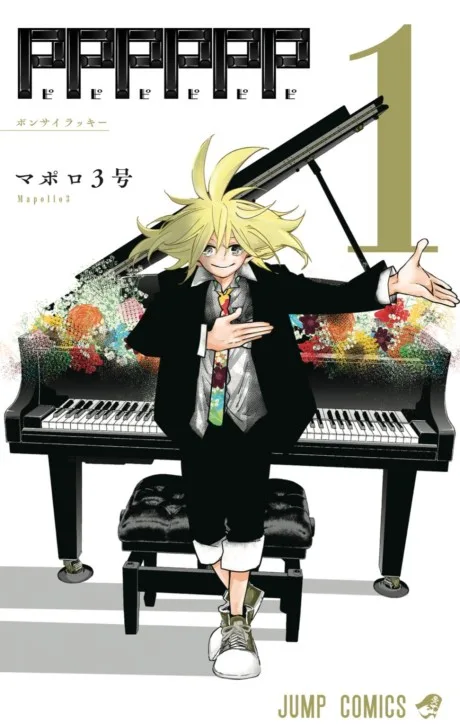
| Series | PPPPPP |
| Blood Type | AB |
| Occupation | Pianist |
| Affiliation | Otogami Family |
| Dislikes | Mediocrity |
| Debut | Chapter 1 |
Contents
Personality
Personality
Gakuon is uncompromising, elitist, controlling, and obsessed with exceptional musical ability. He divides pianists sharply between geniuses and ordinary performers, with little interest in effort when he believes a player lacks the innate qualities necessary to produce meaningful music.
That worldview extends directly into his parenting. Gakuon treats his children's abilities as something that must be cultivated into excellence and can respond harshly when they resist the path he has chosen for them. Mimin Otogami's refusal to conform particularly frustrates him because her natural genius is accompanied by an equally strong desire to play however she wants.
His arrogance is supported by genuine accomplishment. Gakuon has competed successfully at the highest levels of classical piano, and his confidence comes from experience as one of the world's foremost performers rather than empty boasting. The existence of Hideo Dada, a pianist capable of defeating him, is therefore especially significant.
Abilities & Powers
Abilities & Powers
Gakuon is an internationally accomplished concert pianist whose competitive history includes victories at major international competitions. His technical ability and musical reputation establish the standard against which the Otogami children are raised.
Like his gifted children, Gakuon is associated visually with piano-key eyes, but his appear this way even outside performances. His musical philosophy places overwhelming importance on natural genius and the ability to produce experiences that ordinary pianists cannot replicate.
Gakuon's broader strength lies in his authority within the classical music world. The Otogami name becomes a recognizable musical brand through his own achievements and those of the six children he trains, giving him influence extending beyond individual performances.
Story Role
Story Role
Gakuon's judgment creates the circumstances from which Lucky's story begins. When the septuplets are young, he identifies Lucky as the sole child who does not meet his expectations and repeatedly distinguishes him from the other six. Chocho opposes Gakuon's treatment of their son, and the family eventually separates, with Lucky remaining with his mother while the others leave Japan with Gakuon.
Gakuon then develops Don Otogami, Reijirou Otogami, Mimin, Fanta Otogami, Sorachika Otogami, and Sikato Otogami into internationally recognized pianists. His expectations affect them differently: some embrace the Otogami standard, while others struggle against the restrictions attached to it.
Lucky's decision to become a pianist consequently challenges more than his own childhood insecurity. Every improvement he makes questions Gakuon's fundamental belief that a person he classified as mediocre cannot create music comparable to genuine genius.
The final part of the story brings Lucky directly back to Gakuon. Their confrontation forces both of them to address the judgment that separated Lucky from the Otogami pianists and the meaning of the different Lucky personalities that emerged from his childhood.
Relationships
Relationships
Lucky Sonoda is Gakuon's son and the child he considers fundamentally different from the other six pianists. Gakuon's rejection profoundly damages Lucky Sonoda's confidence and becomes one of the primary obstacles Lucky tries to overcome.
Chocho Sonoda is Gakuon's former wife and the mother of his seven children. Chocho Sonoda defends Lucky against Gakuon's treatment and takes him with her when the family separates.
Don Otogami, Reijirou Otogami, Mimin Otogami, Fanta Otogami, Sorachika Otogami, and Sikato Otogami are Gakuon's other children and the six pianists he raises as prodigies. His standards exert enormous influence over how each understands talent, performance, and the Otogami name.
Hideo Dada is a fellow pianist with a history of competition against Gakuon. Hideo Dada's ability to defeat him and his later decision to teach Lucky place the two pianists on opposing sides of Lucky's musical development.