Appears In
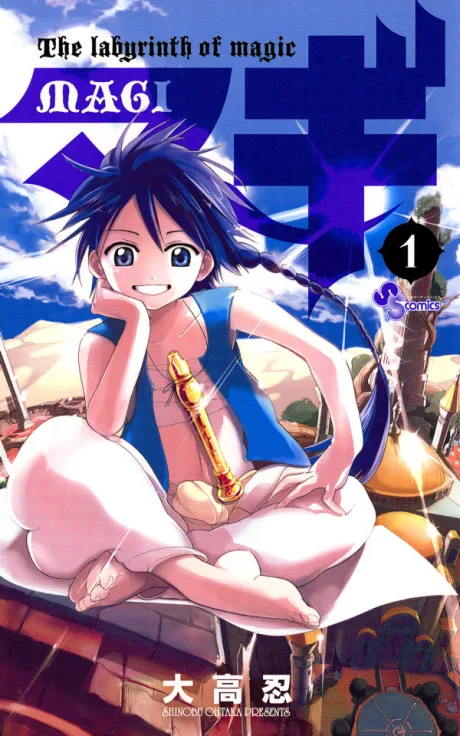
Quick Facts
| Gender | Male |
| Age | 17 |
| Role | MAIN |
| Series | Magi: The Labyrinth of Magic |
| Full Name | Alibaba Saluja |
| Japanese Name | アリババ・サルージャ |
| Romanization | Aribaba Sarūja |
| Age | 17 at introduction; 22 physically in the final arc |
| Height | 168 cm; 170 cm in the final arc |
| Weight | 64 kg |
| Gender | Male |
| Homeland | Balbadd |
| Occupation | Dungeon Capturer, swordsman, political leader, merchant |
| King Vessel | Chosen by Aladdin |
| Djinn | Amon |
| Metal Vessel | A royal sword formerly owned by his father |
| Primary Magic Attribute | Fire |
| Japanese Voice Actor | Yūki Kaji |
| English Voice Actor | Erik Scott Kimerer |
Contents
Background
Background
Alibaba was born in the impoverished quarters of Balbadd as the son of Rashid Saluja, the kingdom’s ruler, and Anise, a woman from outside the royal court. He spent his earliest years among the city’s poor alongside Cassim and Mariam. These experiences gave him an enduring familiarity with poverty, hunger, criminality, and the resentment felt by citizens whom the ruling class had neglected.
After Anise’s death, Rashid brought Alibaba into the palace and formally recognized him as the third prince. Alibaba received a broad royal education that included economics, languages, politics, etiquette, and Balbadd’s distinctive style of swordsmanship. Barkak served as one of his principal instructors, while his older half-brothers Ahbmad Saluja and Sahbmad Saluja occupied more prominent places in the succession.
Alibaba never felt entirely at home in the palace. His origins made him sensitive to class prejudice, while his separation from Cassim created a widening divide between their lives. An attempt to reconnect with his childhood friend had disastrous consequences for the royal household, leaving Alibaba burdened by guilt and reluctant to accept positions of responsibility.
He eventually left Balbadd and found work transporting goods near Qishan. There he met Aladdin, whose unusual powers and uncomplicated faith in him encouraged Alibaba to pursue his long-held dream of conquering a Dungeon. Their expedition into Amon placed him on the path toward becoming a King Vessel and forced him to confront the difference between seeking wealth for himself and acquiring power that could affect entire nations.
Personality
Personality
Alibaba is compassionate, sociable, and unusually attentive to the hardships of common people. His childhood in Balbadd’s slums prevents him from viewing poverty as an abstract political problem, while his palace education allows him to understand the institutions that perpetuate it. He consequently tends to approach conflicts by asking how their resolution will affect ordinary citizens rather than concentrating only on rulers and armies.
Despite his intelligence, Alibaba initially lacks confidence in his own judgment. He often compares himself unfavorably with more visibly powerful figures and fears repeating the mistakes he made in Balbadd. This uncertainty can make him hesitant at decisive moments, but it also prevents him from treating leadership as an entitlement. He seeks advice, questions his motives, and gradually learns to distinguish prudent consultation from avoidance of responsibility.
Alibaba has a comic, less dignified side that contrasts with his princely background. He is susceptible to flattery, becomes awkward around attractive women, and occasionally indulges in fantasies of romance or social success. His attempts to appear sophisticated frequently expose his inexperience, particularly when dealing with affection. These traits humanize him without erasing his capacity for serious political thought.
He is strongly opposed to needless killing and repeatedly tries to reach opponents through dialogue. This idealism is not simple pacifism: Alibaba will fight when lives are threatened, and he becomes a skilled combatant capable of using overwhelming force. His restraint instead reflects a belief that victory is incomplete if it leaves the underlying causes of hatred untouched.
As the story progresses, Alibaba becomes more patient, pragmatic, and resilient. He retains his emotional openness but grows less dependent on approval from mentors or powerful allies. His mature leadership rests on negotiation, trade, and mutual interest as much as combat, giving him a form of influence distinct from that of conventional conquerors.
Appearance
Appearance

Alibaba is a young man with golden-blond hair, golden eyes, and relatively soft facial features inherited from his mother. A prominent lock of hair rises from the top of his head, echoing a similar feature seen in his father. His early height of 168 cm gives him an average, compact build rather than the imposing physique of many warriors he encounters.
At the beginning of the series, he wears clothing suited to travel and physical work: loose trousers, boots, a short vest, and a sash used to secure his weapon. A thin red cord remains tied around his neck. His costume combines the practical dress of a laborer with details suggestive of his Balbadd heritage, visually reflecting his position between common and royal society.
Alibaba’s appearance changes as his responsibilities broaden. During his training in the Reim Empire, he wears a darker tunic and clothing suitable for arena combat. He also acquires visible scars, including marks left during his gladiatorial experiences, which reflect the more disciplined and physically demanding stages of his development.
His Djinn Equip transforms him far more dramatically. Amon’s power covers portions of his body in dark, armor-like material and produces garments associated with the Djinn’s fiery nature. His Metal Vessel becomes a large black blade capable of generating intense flames, though Alibaba later learns to compress the weapon into a lighter form compatible with Balbadd royal swordsmanship.
By the final portion of the story, Alibaba is taller and dresses with greater formality, frequently appearing in clothing appropriate to a statesman or merchant. His mature appearance preserves his recognizable hair and expressive features while conveying the confidence he lacked in his early adventures.
Abilities & Powers
Abilities & Powers
Alibaba possesses an extensive royal education and a strong analytical mind. He understands commerce, administration, diplomacy, and multiple cultures, enabling him to interpret political situations more effectively than his initially modest circumstances suggest. His intelligence is particularly evident when he develops economic strategies or identifies incentives capable of bringing hostile groups into cooperation.
He was trained from childhood in Balbadd’s royal swordsmanship, a fast and refined discipline designed around compact movements and precise attacks. After leaving the palace, his skills became rusty, but training under Sharrkan restored his fundamentals and exposed him to additional fighting styles. Alibaba eventually combines this instruction with his original royal technique rather than merely imitating his teacher.
During his stay in Reim, Alibaba learns Magoi Manipulation from the Yambala gladiators under Shambal Ramal. This practice directs Magoi through the body to strengthen attacks, reinforce defenses, and disrupt an opponent’s internal flow. Mastering it improves his physical combat and helps him confront enemies whose abilities cannot be overcome through ordinary swordsmanship.
As Amon’s Dungeon Capturer, Alibaba can draw fire magic from his Metal Vessel. His original vessel is a knife he had carried for years, but after it is damaged he transfers Amon into a royal sword connected to Rashid. The weapon can ignite, project fire, and assume increasingly powerful configurations as Alibaba develops greater control over Djinn Weapon Equip and full-body Djinn Equip.
Alibaba’s full Djinn Equip gives him extensive command over fire and greatly increases his offensive power, mobility, and durability. He can surround himself with flames, generate concentrated fiery slashes, and withstand extreme heat. His largest attacks consume substantial Magoi, requiring him to judge carefully when their destructive potential justifies the cost.
After his soul spends what feels like a century in a distant dimension, Alibaba returns with an altered perception of time. He can process events with extraordinary calm and precision, making surrounding movement appear nearly motionless from his perspective. This experience does not give him limitless physical speed, but it greatly improves his reactions, concentration, and ability to analyze rapidly changing situations.
Named Techniques
Named Techniques
-
Amol Saiqa — Amon’s Sword, the transformed state of Alibaba’s Metal Vessel. It generates and controls fire while serving as the basis for his Djinn Weapon Equip.
-
Amon’s Royal Sword — A compressed version of Amon’s weapon shaped to suit Alibaba’s Balbadd royal swordsmanship. Its lighter construction allows him to use his original precision-based style more effectively.
-
Amol Dherrsaiqa — A high-output technique that surrounds Alibaba in roaring fire and channels the flames through his sword, producing a powerful incendiary assault.
-
Flame Wall — A defensive application of Amon’s power that creates a barrier of fire to block, repel, or restrict an opponent.
-
Amol Al-Bador Saiqa — Alibaba’s Extreme Magic. It manifests an enormous fiery figure wielding a sword and delivers a massive cutting attack capable of damaging exceptionally durable targets and magical barriers.
-
Magoi Manipulation — A combat method learned from the Yambala gladiators. Alibaba circulates Magoi through his body and weapon to enhance his strikes or interfere with another fighter’s energy flow.
-
Balbadd Royal Swordsmanship — The formal sword discipline taught to members of Balbadd’s royal family. Alibaba uses its short, efficient movements in combination with Amon’s compressed weapon.
Relationships
Relationships
Aladdin — Aladdin is Alibaba’s closest friend and the Magi who chooses him as a King Vessel. Their partnership begins during the conquest of Amon and develops into a bond defined by trust, occasional separation, and a shared desire to improve the world without imposing a single person’s will upon it.
Morgiana — Alibaba initially helps free Morgiana from enslavement, after which she becomes one of his most dependable companions. Their friendship gradually develops into mutual romantic affection, although Alibaba’s insecurity and awkwardness repeatedly complicate his attempts to express himself. They eventually marry after the final conflict.
Cassim — Cassim is Alibaba’s childhood friend and adopted brother from Balbadd’s slums. Their relationship combines deep affection with resentment born from their different social positions, and Cassim’s anger forces Alibaba to confront both his guilt and the limits of good intentions unsupported by decisive action.
Mariam — Mariam shared Alibaba and Cassim’s childhood in the slums and was treated as their younger sister. Her presence represents the improvised family they formed before Alibaba entered the palace.
Rashid Saluja — Rashid is Alibaba’s father and the king who brings him into Balbadd’s royal household. He recognizes Alibaba’s intelligence and potential, provides him with a princely education, and leaves him with both a political inheritance and unresolved guilt.
Anise — Anise is Alibaba’s mother and the source of his earliest connection to Balbadd’s poor. His memories of her kindness strongly influence his empathy and his reluctance to disregard people who lack status or power.
Ahbmad Saluja — Ahbmad is Alibaba’s elder half-brother and Balbadd’s ruling king during Alibaba’s return. Alibaba opposes his exploitative policies and challenges the idea that royal birth alone makes someone fit to govern.
Sahbmad Saluja — Sahbmad is Alibaba’s other elder half-brother. Although timid and politically subordinate, he provides information that helps Alibaba understand the forces influencing Balbadd’s government.
Amon — Amon is the fire Djinn obtained through Alibaba’s first Dungeon conquest. He resides in Alibaba’s Metal Vessel, grants him Djinn Equip, and occasionally advises him about the responsibilities and dangers associated with his power.
Sinbad — Sinbad serves at different times as Alibaba’s protector, political model, employer, and ideological opponent. Alibaba admires his accomplishments but becomes increasingly wary of his tendency to direct other nations toward outcomes chosen by himself.
Hakuryuu Ren — Hakuryuu begins as Alibaba’s companion during the Zagan expedition. Their shared concern for their homelands gives them common ground, but their opposing attitudes toward vengeance and political violence eventually produce a severe conflict before they regain a measure of mutual understanding.
Kougyoku Ren — Kougyoku develops a sincere friendship with Alibaba despite the political tension between Balbadd and the Kou Empire. He treats her as an individual rather than merely an imperial princess, and he later supports her efforts to govern in her own right.
Judar — Judar initially regards Alibaba as an obstacle and favors other candidates for kingship. After Alibaba’s soul is displaced, the two endure an extended journey together, and Judar becomes instrumental in returning him to the living world.
Sharrkan — Sharrkan trains Alibaba in swordsmanship while he resides in Sindria. His demanding instruction helps Alibaba rebuild his confidence and eventually recognize that Amon’s oversized weapon must be adapted to his natural fighting style.
Barkak — Barkak is Alibaba’s early sword instructor and a loyal Balbadd soldier. His training supplies the foundation for Alibaba’s royal swordsmanship and reconnects him with the discipline expected of a prince.
Toto — Toto meets Alibaba during his training in Reim and initially confronts him as a gladiator. She becomes a trusted comrade who respects his persistence and accompanies him through later political upheavals.
Olba — Olba first encounters Alibaba as one of the children controlled by pirates. He later becomes a capable ally and joins the group associated with Alibaba and Toto.
Shambal Ramal — Shambal Ramal oversees Alibaba’s Magoi Manipulation training among the Yambala gladiators. His instruction helps Alibaba develop a more efficient and technically grounded approach to combat.
Story Role
Story Role
Alibaba enters the narrative as a laborer who dreams of conquering a Dungeon but initially lacks the courage to act independently. Meeting Aladdin transforms that ambition into a genuine expedition. Their conquest of Amon establishes the central partnership between a Magi and his King Vessel, while Alibaba’s decision to free Morgiana demonstrates that his first use of newfound wealth is guided by empathy rather than personal luxury.
The Balbadd arc places Alibaba at the center of a conflict between monarchy, foreign influence, popular revolt, and organized crime. Operating for a time as the masked leader of the Fog Troupe, he tries to defend the poor without provoking a destructive civil war. His eventual public return as a prince forces him to confront Ahbmad’s government, Cassim’s radicalism, and his own responsibility for abandoning the kingdom.
In Sindria and the Zagan expedition, Alibaba develops from a politically burdened prince into a more capable adventurer. His interactions with Hakuryuu, Kougyoku, and other members of the Kou royal family broaden the story’s examination of kingship. Rather than accepting that a King Vessel must dominate others, he begins to define leadership through accountability and cooperation.
The Reim and Magnostadt portions of the narrative separate Alibaba from Aladdin and allow him to grow independently. His gladiatorial training gives him better control over Magoi, while the conflict at Magnostadt demonstrates that martial power alone cannot resolve tensions among magicians, non-magicians, and imperial states. Alibaba operates as both fighter and mediator, reinforcing his dual role in the series.
During the Kou Empire conflict, Alibaba opposes Hakuryuu’s campaign of vengeance and is struck by Belial’s power, which sends his soul beyond the ordinary world while his body is lost. After returning years later, he enters a radically changed political landscape and uses commercial reform to help stabilize Kou rather than attempting to seize it militarily.
In the final arc, Alibaba becomes one of the principal opponents of Sinbad’s plan to unify every soul under a single predetermined destiny. His resistance is philosophical as well as personal: he argues that even a peaceful world loses its meaning if individuals cannot choose their own paths. His role culminates in helping preserve human freedom and building a future based on connection among nations rather than control by one perfect king.
Character Development
Character Development
Alibaba’s earliest conflict is between ambition and self-doubt. He wants wealth, status, and the power to change his circumstances, but he is ashamed of his failures and afraid to act without stronger companions. The conquest of Amon does not immediately eliminate this insecurity; it instead gives him responsibilities that make avoidance increasingly impossible.
His return to Balbadd teaches him that sincerity is insufficient without political judgment. Alibaba cares deeply for both the kingdom and Cassim, yet his attempts to satisfy every side allow the crisis to intensify. By accepting his own mistakes, he begins to understand leadership as the willingness to make difficult decisions while remaining accountable for their consequences.
Training in Sindria and Reim provides a parallel physical development. Alibaba initially relies heavily on Amon’s raw power and struggles with a weapon poorly suited to him. Through Sharrkan’s instruction, Magoi Manipulation, and combat experience, he learns to integrate princely swordsmanship, Dungeon-derived magic, and practical battlefield tactics into a coherent personal style.
His relationship with Hakuryuu tests the limits of Alibaba’s belief in reconciliation. Alibaba recognizes the legitimacy of Hakuryuu’s suffering but rejects the conclusion that vengeance justifies coercion and mass violence. Their conflict forces him to defend his ideals against someone whose pain he understands, rather than against an opponent he can simply condemn.
Alibaba’s prolonged spiritual displacement radically changes his sense of time and patience. On returning, he is more composed and less concerned with proving himself through spectacular victories. He turns toward trade, infrastructure, and negotiation, demonstrating that his growth has made him capable of producing change without depending on royal title or Djinn power.
His final opposition to Sinbad completes his development from a hesitant follower into an independent leader. Alibaba can respect Sinbad’s intentions while rejecting his solution, and he no longer needs a universally admired figure to validate his judgment. The conclusion presents him as a partner to Morgiana, a friend to Aladdin, and a statesman whose authority arises from chosen responsibility rather than inherited rank.
Etymology
Etymology
Alibaba’s given name derives from Ali Baba, the protagonist of “Ali Baba and the Forty Thieves,” a story commonly associated with the collection known in English as One Thousand and One Nights. The reference aligns with the series’ broader use of names, places, and motifs drawn from Arabic, Persian, and South Asian storytelling traditions.
The original Ali Baba is a poor man whose discovery of hidden treasure changes his circumstances. Magi adapts this association through Alibaba’s humble upbringing, desire for wealth, and conquest of a treasure-filled Dungeon, but expands the character into a prince, revolutionary figure, swordsman, and economic reformer.
“Saluja” identifies Alibaba with Balbadd’s royal family. Within the story, the surname connects him to Rashid, Ahbmad, and Sahbmad while distinguishing the status inherited from his father from the slum identity formed during his childhood.
His temporary title “Wonder Man” is associated with his masked activities in Balbadd. The alias reflects his effort to operate as a symbolic champion of the poor while concealing the politically explosive fact that a royal prince is participating in resistance against the government.
Trivia
Trivia
-
Alibaba is the capturer of Amon, the seventh Dungeon to appear in the world.
-
His first Metal Vessel is a small knife that he keeps close at hand; Amon is later transferred to a royal sword connected to Rashid.
-
His characteristic upright lock of blond hair resembles his father’s hairstyle.
-
Alibaba’s red neck cord remains part of his design through several major costume changes.
-
He enjoys commerce and proves especially talented at identifying how trade can reshape political relationships.
-
His formal education allows him to read, negotiate, and discuss state policy despite his introduction as a cart driver.
-
The scars acquired during his Reim training remain visible afterward, marking his development as a close-quarters fighter.
-
Yūki Kaji voices Alibaba in Japanese, while Erik Scott Kimerer performs the role in the English-language anime dub.
In Other Media
In Other Media
Alibaba appears throughout the television adaptations Magi: The Labyrinth of Magic and Magi: The Kingdom of Magic. The anime follows his early meeting with Aladdin, the conquest of Amon, the Balbadd crisis, his training in Sindria and Reim, and his involvement in the Magnostadt conflict.
He also appears in Magi-related video games, including crossover titles built around characters published in Weekly Shōnen Sunday. These appearances generally emphasize his swordsmanship, Amon’s fire abilities, and his status as one of the manga’s principal heroes.
Alibaba is featured extensively in official illustrations, guidebooks, merchandise, drama material, and character-focused promotional releases. His visual association with Amon’s flames and the Balbadd royal sword makes his Djinn Equip one of his most frequently used designs outside the manga.
The prequel series Magi: Adventure of Sinbad is set before Alibaba’s birth and therefore does not place him among its active cast. Its depiction of Rashid, Balbadd, and Sinbad’s earlier career nevertheless supplies historical context for the political world Alibaba inherits.
Reception
Reception
Alibaba is widely recognized as one of Magi’s two principal protagonists alongside Aladdin. Commentary on the series frequently distinguishes Aladdin’s connection to magic and ancient history from Alibaba’s more human-scale struggles with poverty, guilt, political responsibility, and self-confidence.
His Balbadd storyline is often treated as a defining early portion of the narrative because it transforms him from an aspiring adventurer into a politically consequential figure. The conflict with Cassim gives his idealism a personal cost and establishes the recurring tension between reconciliation and violent revolution.
The character’s progression from an insecure Dungeon Capturer to a capable swordsman and economic reformer has been a prominent aspect of his reception. His victories are often based on persuasion, compromise, or commercial planning rather than superior magical power, distinguishing him from many battle-manga protagonists.
Yūki Kaji’s performance contributed to Alibaba’s prominence in the anime adaptation, balancing his comedic embarrassment, emotional vulnerability, and forceful battle scenes. Erik Scott Kimerer’s English performance likewise presents him as both an approachable young adventurer and a developing political leader.
Alibaba’s relationships with Aladdin, Morgiana, Cassim, Hakuryuu, and Sinbad have also attracted substantial attention because each tests a different aspect of his character. Together, they frame him not as a naturally flawless ruler but as a person who repeatedly fails, reconsiders his choices, and continues working toward forms of leadership that preserve individual freedom.
Related Characters
 SUPPORTING
Rashid Saluja
Magi: The Labyrinth of MagicBalbadd's previous king and father of Alibaba, Abhmad and Sabhmad. Also he had close connections with Sinbad as he taught him a lot of things.
 SUPPORTING
Anise
Magi: The Labyrinth of MagicAlibaba's mother. He described her as a gentle and cheerful person.
 SUPPORTING
Cassim
Magi: The Labyrinth of MagicCassim was an old friend and the adoptive brother of Alibaba Saluja. When Cassim was younger, he lived in the slums of Balbadd with his sister and father. One day, his father was b
 SUPPORTING
Mariam
Magi: The Labyrinth of MagicMariam was the younger sister of Kassim. Mariam was a kind young girl, she would cry when her father has become violent. After her father disappeared, she and her brother were adop
 SUPPORTING
Barkak
Magi: The Labyrinth of MagicBarkak is the right general of the Imperial Army of Balbadd. Barkak is the person who taught Alibaba royal swordplay.
 SUPPORTING
Sharrkan
Magi: The Labyrinth of MagicOne of the eight generals, he has terrific skills in fencing. He is a poseur. He has a personality to not do anymore work after off-duty. He also goes drinking often. His optimisti

 MAIN
MAINAladdin
Magi: The Labyrinth of MagicA mysterious young boy with a huge djinn within his flute. His name is based on 'Aladdin and the Magic Lamp'. He travels in search of metal vessels that contain other djinns. He ha
 MAIN
MAINMorgiana
Magi: The Labyrinth of MagicDescendant of the hunting tribe, Fanalis. Her name is based on the slave girl who served Alibaba in "Alibaba and the forty thieves". Morgiana was Jamil’s slave before. She was emot
 SUPPORTING
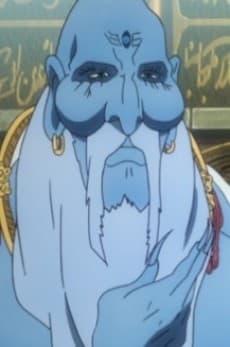
Amon
Magi: The Labyrinth of MagicA djinn of stern and etiquette. In the 7th Dungeon's basement, in a city that spread out there, Aladdin and the others met Amon, a polite yet rigid djinn. He materialized in the fo
 SUPPORTING
Sinbad
Magi: The Labyrinth of MagicHe is the king of Sindria and the leader of the Alliance of the Seven Seas. He was 14 years old when he first captured a dungeon, the first dungeon "Bael". Since then, he had saile
 SUPPORTING
Hakuryuu Ren
Magi: The Labyrinth of MagicHakuei's younger brother, he is currently the fourth prince in the Kou Empire. As he was taught to be able to do everything on his own by his sister, he is good at cooking. Because
 SUPPORTING
Kougyoku Ren
Magi: The Labyrinth of MagicKougyoku Ren is the Kou Empire's eighth Princess. Kougyoku is a Dungeon Capturer and owner of the Djinn, Vinea. Kougyoku is a very willful person. She tends to act childish, but sh
 SUPPORTING
Judar
Magi: The Labyrinth of Magic(first appearance), 23 (now) Judar is one of the four Magi in the current era and a Magician who specializes in Ice Magic. He is the former Oracle of Al-Thamen and the Kou Empire a
 SUPPORTING
Toto
Magi: The Labyrinth of MagicToto is Kohza's father and the only man left living in the deserted city of Yuba. Originally, Toto was a relatively fat but healthy looking old man. However due to the three year d
 SUPPORTING
Olba
Magi: The Labyrinth of Magicis a former Pirate and a prominent member of Umm Madaura's Crew. When the crew was captured, he, along with his companions, were sent to Sindria, where they currently reside.