Cover

| Name | Edward Elric |
| Japanese | エドワード・エルリック |
| Role | Main Character |
| Age | 15-16 (series), 18 (movie, End of the series) |
Appears In
Quick Facts
| Gender | Male |
| Age | 15-16 (series), 18 (movie, End of the series) |
| Role | MAIN |
| Series | Fullmetal Alchemist |
| Height | Approximately 149 cm at the beginning of the series |
| Age | 15 through most of the series |
| Gender | Male |
| Eye Color | Gold |
| Hair Color | Blond |
| Voice Actor (JP) | Romi Park |
| Voice Actor (EN) | Vic Mignogna |
| Likes | Alchemy, research, traveling |
| Dislikes | Milk, comments about his height |
| Affiliation | Amestrian State Military |
| Aliases | Fullmetal Alchemist, Fullmetal, Ed |
| Father | |
| Mother | |
| Brother | |
| Teacher | |
| Debut | Chapter 1 |
Contents
1.Profile3
Background
Background
Edward is born in the rural Amestrian town of Resembool to Van Hohenheim and Trisha Elric. He and his younger brother, Alphonse Elric, demonstrate an unusual aptitude for alchemy while still children, studying from the books left in their father's home. Hohenheim's departure leaves Trisha raising the brothers alone, and Edward develops considerable resentment toward the father who seemingly abandoned them.
Trisha encourages her sons' early experiments and takes visible pride in their ability. When she dies while Edward and Alphonse are still children, the loss becomes the central trauma of their early lives. The brothers refuse to accept that death must be permanent and begin researching human transmutation, an alchemical taboo intended to reconstruct a human body.
Before attempting it, they seek formal training under Izumi Curtis. Izumi refuses to teach them alchemy immediately and first subjects them to intensive survival and physical training, requiring the brothers to understand the relationship between individual life and the larger natural cycle. Her philosophy of "one is all, all is one" becomes fundamental to Edward's later understanding of alchemy.
The brothers eventually return to Resembool and attempt to transmute their mother. The experiment catastrophically fails. Edward loses his left leg as the toll demanded by the Gate of Truth, while Alphonse loses his entire body. Edward sacrifices his right arm to bind Alphonse's soul to a nearby suit of armor.
Childhood friend Winry Rockbell and her grandmother Pinako Rockbell save Edward from bleeding to death and construct automail prosthetics for his missing limbs. The rehabilitation is agonizing, but Edward pushes through it with the goal of becoming mobile enough to pursue a solution for Alphonse.
Lieutenant Colonel Roy Mustang recognizes Edward's potential and suggests that becoming a State Alchemist would give him access to military research materials unavailable to civilians. Edward accepts despite his distrust of military authority.
At twelve, he passes the State Alchemist examination and receives the title Fullmetal Alchemist from Führer King Bradley. His certification grants him the resources and freedom to travel throughout Amestris, but it also makes him legally part of the military hierarchy. The official Brotherhood character profile identifies him as the youngest person to obtain State certification at twelve.
Edward and Alphonse spend the following years searching for information about the Philosopher's Stone, which appears capable of bypassing the ordinary limitations of equivalent exchange. Their journey takes them through incidents involving corrupt alchemists, military officers, serial killers and researchers whose work approaches the same forbidden territory as their own.
The brothers gradually discover that the Philosopher's Stone is not the simple miracle they hoped to find. A genuine Stone is created using human lives, making its apparent ability to ignore equivalent exchange dependent upon the stored souls consumed as fuel. Edward consequently refuses to use one merely to restore his and Alphonse's bodies.
Their investigation draws them toward the homunculi, mysterious beings including Lust, Envy, Gluttony, Greed, Wrath, Sloth and Pride. What initially appears to be a series of isolated conspiracies eventually reveals connections between human transmutation, the military government and the historical development of Amestris itself.
Edward eventually learns that the nationwide wars, massacres and territorial expansions of Amestris have been manipulated to create a gigantic transmutation circle using the country and its population. The architect of the plan is Father, a being whose origins are inseparable from Hohenheim's past and the destroyed civilization of Xerxes.
Personality
Personality
Edward is stubborn, impulsive and exceptionally sensitive about his height. Comments that can even remotely be interpreted as references to being short frequently provoke exaggerated anger, and he has a tendency to imagine far more elaborate insults than anyone actually said. His official Brotherhood profile explicitly identifies his small stature as an inferiority complex and warns that terms such as "small" or "tiny" reliably enrage him.
His temper extends beyond height. Edward has little natural respect for hierarchy and regularly challenges military officers, clergy and political authorities when he considers their reasoning dishonest or unjust. Becoming a State Alchemist gives him military rank and privileges, but it never transforms him into an obedient soldier.
He is intensely rational and initially treats alchemy as the framework through which nearly everything can be explained. The principle of equivalent exchange—obtaining something requires giving something of equal value—shapes both his scientific reasoning and his early understanding of life.
Edward is openly skeptical of religion and miraculous explanations. His experiences with false prophets and manufactured miracles reinforce his preference for evidence over faith, though encounters with the Truth force him to acknowledge phenomena that cannot be reduced comfortably to ordinary scientific categories.
His outward abrasiveness hides considerable empathy. Edward reacts strongly to people who exploit the powerless and is especially disturbed by adults who use children as instruments in experiments, wars or political schemes.
His compassion becomes particularly evident when his own research reaches morally unacceptable conclusions. The Philosopher's Stone could potentially solve his greatest personal problem, yet he refuses to accept a solution based upon sacrificing other human beings.
Edward also possesses a pronounced sense of responsibility. He does not blame Alphonse for their failed human transmutation and instead assumes much of the guilt himself, believing that as the older brother and principal driving force behind the experiment, he should bear its consequences.
This protectiveness can become controlling. Edward sometimes withholds information or attempts to face danger alone because he believes doing so will prevent Alphonse, Winry or others from being harmed.
His relationship with Alphonse frequently corrects this tendency. Al is calmer and more diplomatic, but he is not simply Edward's dependent; he repeatedly insists upon sharing both the consequences of their past and the decisions governing their future.
Edward's pride is substantial, though it evolves over the series. He is proud of his intelligence, his alchemical ability and his accomplishments as a State Alchemist, sometimes dismissing ideas before fully examining them.
Failure repeatedly forces him to reconsider that attitude. His encounters with Scar, the homunculi, Xingese alkahestry and people whose knowledge exceeds his own teach him that expertise does not make him universally correct.
He also develops a more complicated understanding of equivalent exchange. The rule remains important to alchemy, but Edward increasingly recognizes that human relationships cannot always be measured through exact reciprocal transactions.
His dislike of milk is another recurring characteristic. The joke frequently intersects with his frustration over his height, since other characters suggest that refusing milk contributes to his growth problem.
Despite his impatience, Edward is an obsessive researcher. He can spend long periods reading technical material, deciphering notes and reconstructing complicated theories from incomplete evidence.
He is also highly adaptable. When a new form of alchemy or combat technique appears, Edward studies the underlying principle rather than simply treating it as unfamiliar magic.
By the later story, his confidence becomes less dependent on proving that alchemy can solve everything. His final major choice demonstrates that he is willing to give up the very ability that once defined his identity when doing so allows him to save Alphonse.
Appearance
Appearance
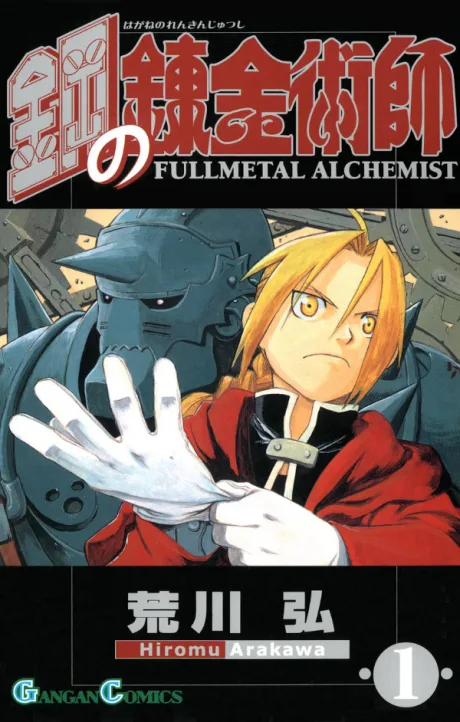
Edward has golden-blond hair and golden eyes, features inherited through his family line. His hair is usually worn long and tied into a braid or ponytail, with a prominent strand rising from the top of his head.
He is conspicuously short during the early and middle portions of the series. Supplementary material and manga jokes play with the exact measurement, but his early height is commonly given at roughly 149 cm, while his actual apparent height can vary depending on his thick-soled boots and deliberately raised hair. His small stature is acknowledged directly in the official Brotherhood character profile.
Edward gradually grows during the story. The change becomes increasingly visible compared with Winry and other recurring characters, particularly in later chapters.
His missing right arm and left leg are replaced with automail prosthetics constructed and maintained primarily by Winry and Pinako. The right arm attaches around the shoulder, while the left leg begins above the knee.
The initial automail is durable but heavy. Traveling to colder northern regions creates additional problems because conventional metal prosthetics become dangerous in extreme temperatures.
Winry therefore supplies Edward with modified northern automail made from lighter materials better suited to Briggs. The reduced weight also improves his movement during combat.
Edward's usual clothing consists of black garments beneath a bright red coat. The back of the coat bears the Flamel symbol associated with his alchemical training under Izumi.
He frequently wears white gloves to conceal the mechanical appearance of his right hand in ordinary public settings. His State Alchemist pocket watch is carried as proof of his government certification.
The watch itself becomes symbolically important because Edward engraves a reminder of the date on which he and Alphonse burned their childhood home and left Resembool. The inscription is intended to prevent him from retreating from the path they chose.
Edward's automail arm is also a combat weapon. He frequently transmutes its outer plating into a short blade, exploiting the fact that its metallic composition makes rapid reshaping straightforward.
He accumulates scars during his travels, including marks around the automail attachment sites. These remain visible reminders that his prosthetics are not effortless replacements but devices physically integrated into damaged tissue.
By the epilogue, Edward has grown substantially taller than in his early teens. He retains his automail left leg, while the fate of his right arm changes during the final confrontation.
Abilities & Powers
Abilities & Powers
Edward is an exceptionally gifted alchemist. His certification at twelve establishes him as a prodigy even by the standards of professional State Alchemists, and his understanding extends across chemistry, biology, metallurgy, structural manipulation and the general theory of transmutation.
Alchemy in Amestris ordinarily requires understanding the composition of matter, deconstructing it and reconstructing it into another form according to equivalent exchange. Most alchemists use prepared transmutation circles to control the process.
Edward does not normally require one. Passing through the Gate and seeing the Truth gives him enough understanding to use his own body as part of the transmutation array.
He activates alchemy by clapping his hands together and then touching the material he intends to transform. The procedure is far faster than drawing a circle during combat and gives him extraordinary tactical flexibility.
Edward frequently reshapes terrain into walls, pillars, spikes, fists and other structures. Because he can improvise from whatever material surrounds him, destroying or confiscating a conventional weapon does little to disarm him.
He is particularly adept at transforming his automail arm into a blade. This produces an immediate melee weapon without requiring him to carry a sword.
His fighting ability is not dependent entirely upon alchemy. Izumi subjects Edward and Alphonse to extensive physical training, leaving both brothers skilled in hand-to-hand combat.
Edward's automail further enhances certain attacks and defensive maneuvers. A metal arm can block blows that would badly injure flesh, while the automail leg adds weight and durability to kicks.
He is fast and agile, often using his smaller frame to maneuver around larger enemies. His northern automail further increases that mobility by reducing the weight of his prosthetics.
Edward's greatest advantage is often improvisation rather than raw strength. He studies opponents during fights and adjusts his transmutations to exploit their composition or habits.
When facing Greed, for example, Edward analyzes the carbon structure underlying the Ultimate Shield rather than attempting indefinitely to overpower it.
He is also capable of learning from techniques he observes. Elements resembling Scar's destructive alchemy, Alex Louis Armstrong's stone manipulation and other specialists appear in Edward's later improvisations.
His knowledge of human biology is extensive but shaped by firsthand recognition of its limits. The failed attempt to reconstruct Trisha permanently destroys any simplistic belief that possessing the chemical ingredients of a human body is sufficient to recreate a person.
Circle-Free Transmutation
Circle-Free Transmutation
Edward can perform ordinary alchemy without drawing an external transmutation circle. He claps his hands together, completing the required circuit through his body, and touches the target material.
This ability makes him one of the most dangerous alchemists in direct combat because there is almost no preparation time between deciding upon a transmutation and executing it.
Deconstruction
Deconstruction
Edward usually carries a transmutation through both decomposition and reconstruction, but he understands that the process can be interrupted after the destructive stage.
Observing other alchemists expands his willingness to use this stage tactically, particularly against structures or artificial materials.
Structural Transmutation
Structural Transmutation
Edward can reshape stone, earth and manufactured materials into defensive barriers, platforms and weapons.
He often raises walls instantly to intercept attacks or creates columns beneath himself and allies to alter position.
Automail Weapon Transmutation
Automail Weapon Transmutation
His right automail arm can be transformed into a blade extending from the forearm.
The technique gives Edward a reusable weapon already attached to his body and allows him to alternate rapidly between hand-to-hand combat and armed strikes.
Chemical and Material Analysis
Chemical and Material Analysis
Edward's ability depends upon understanding what he is manipulating. He has enough scientific knowledge to identify material composition and determine how its structure might be changed.
This becomes particularly valuable against opponents whose powers initially appear supernatural but are actually based on identifiable substances.
Soul Transmutation
Soul Transmutation
Edward possesses rare practical experience with soul binding because he attaches Alphonse's soul to armor after the failed human transmutation.
The feat is performed under catastrophic pressure and costs him his right arm. Even so, successfully binding a human soul demonstrates technical ability far beyond ordinary alchemical practice.
Late in the story, Edward uses sophisticated transmutation principles involving his own body and Philosopher's Stone mechanics to interact directly with Pride's internal structure.
His final alchemical act is qualitatively different from ordinary material transmutation: Edward offers his own Gate of Truth—the source enabling his alchemical ability—as payment to retrieve Alphonse.
Named Techniques
Named Techniques
Edward does not generally announce formal technique names. His combat style relies on rapid applications of general alchemical principles rather than a fixed catalog of attacks.
-
Circle-Free Transmutation: Edward claps his hands and uses his body to complete the transmutation array, allowing immediate alchemy without a drawn circle.
-
Automail Blade: Edward transmutes the outer structure of his automail right arm into a short blade for close combat.
-
Stone Spikes: He raises sharpened formations from stone or earth, either to attack directly or control an opponent's movement.
-
Earthen Wall: Edward rapidly reshapes the ground into barriers capable of blocking projectiles, explosions and charging enemies.
-
Stone Fist / Battering Structure: He frequently creates large hand- or fist-shaped structures from the surrounding terrain to strike targets with much greater mass than his physical body could provide.
-
Pillar Transmutation: Edward raises columns from the ground to gain elevation, interrupt attacks or reposition allies and enemies.
-
Weapon Construction: Spears, swords and other weapons can be produced from nearby material when his automail blade is insufficient.
-
Deconstruction: By stopping an alchemical reaction after the breakdown stage, Edward can destroy structures rather than reconstructing them.
-
Carbon Manipulation: After understanding the chemistry underlying Greed's armor, Edward demonstrates the ability to alter carbon arrangements rather than treating the Ultimate Shield as an inexplicable power.
His most important "technique" remains adaptability. Edward's combat alchemy changes according to environment, opponent and available material rather than following a rigid sequence of attacks.
Relationships
Relationships
Alphonse Elric is Edward's younger brother and the person around whom most of Edward's decisions revolve. Edward Elric blames himself heavily for Alphonse Elric's loss of his body and considers restoring him his highest responsibility.
Their relationship is nevertheless not one of guardian and dependent. Alphonse Elric is often calmer, more diplomatic and in some respects the better martial artist, while Edward contributes greater impulsiveness and rapid alchemical improvisation. The brothers argue, compete and occasionally misunderstand each other, but their trust remains fundamental.
When doubts arise over whether Alphonse Elric's memories are genuine, Edward Elric is devastated that his brother could suspect he fabricated them. Their reconciliation reinforces that their shared past cannot be reduced to alchemical evidence alone.
[During the final battle, Alphonse Elric sacrifices his bound soul to restore Edward's missing right arm, allowing Edward to continue fighting. Edward later gives up his own Gate of Truth and therefore his ability to use alchemy in exchange for bringing Alphonse's body and soul back together.](#spoiler)
Winry Rockbell is Edward's childhood friend, automail mechanic and eventual romantic partner. Edward Elric relies upon her technical skill to maintain the prosthetics that make his independent life possible, although his tendency to damage them repeatedly is a constant source of conflict.
Their friendship is built on shared childhood history and the losses created by war. Winry Rockbell's parents were doctors killed during the Ishvalan conflict, while Edward and Alphonse lose their mother and later their original bodies.
Edward becomes especially protective when Winry is drawn into military conspiracies. At the same time, Winry Rockbell rejects being treated merely as someone waiting safely at home and repeatedly insists on contributing through the skill she possesses.
Their affection develops gradually rather than beginning as an explicit romance. Edward is far less comfortable discussing emotional intimacy than discussing alchemy and struggles to express what Winry means to him directly.
[After the central conflict ends, Edward Elric and Winry Rockbell eventually marry and have children. His famously awkward proposal frames marriage through equivalent exchange before Winry immediately rejects the idea that love should be divided into precise percentages.](#spoiler)
Van Hohenheim is Edward's father and the target of much of his childhood resentment. Edward Elric interprets Hohenheim's departure as abandonment and often refuses even to call him "Father."
Their reunion is uncomfortable because Edward sees an apparently unchanged man returning after years of absence. Hohenheim, meanwhile, carries information and burdens that Edward does not initially understand.
[Edward eventually learns that Van Hohenheim is an extraordinarily long-lived human Philosopher's Stone created during the destruction of Xerxes, and that his departure from the family was connected to preparations against Father's plan rather than simple indifference.](#spoiler)
Although Edward never becomes openly sentimental toward Hohenheim, their relationship improves considerably. Hohenheim's willingness to offer his remaining life as payment for Alphonse affects Edward deeply, even though Edward refuses the sacrifice.
Trisha Elric is Edward's mother and the emotional center of his childhood. Edward Elric's desire to see her again leads directly to the human transmutation that changes both brothers' lives.
Her encouragement of their early alchemy helps explain why Edward associates the discipline with both love and guilt. He initially believes that enough knowledge should allow him to undo death itself.
Later evidence forces Edward and Alphonse to recognize that the body created during their failed transmutation was not actually Trisha. The discovery is painful but also liberating because it confirms that they did not drag their mother's soul back into a malformed body.
Izumi Curtis is Edward's alchemy teacher and one of the few adults who can instantly intimidate him into obedience. Edward Elric respects her enormously despite complaining about the harshness of her training.
Their relationship deepens when the brothers discover that Izumi Curtis has personal experience with human transmutation. She attempted to resurrect her stillborn child and lost internal organs as the toll. The revelation transforms her from an apparently invincible teacher into someone carrying a guilt closely resembling theirs.
Roy Mustang recruits Edward into the State Alchemist system and becomes his commanding officer. Edward Elric frequently mocks and challenges Mustang, while Mustang retaliates through authority, sarcasm and deliberately inconvenient assignments.
Underneath their arguments is substantial trust. Edward recognizes Mustang's political ambition as different from ordinary careerism because Roy wants enough authority to reform the country's military system.
Edward Elric also serves Mustang's ambitions indirectly by uncovering information the military hierarchy would prefer concealed. Mustang, in turn, repeatedly uses his position to protect or assist the brothers despite presenting many interactions as official business.
[After the conspiracy within Amestris becomes undeniable, Roy Mustang and Edward effectively become allies in the same resistance, despite their earlier commander-subordinate relationship.](#spoiler)
Riza Hawkeye interacts with Edward primarily through Mustang's unit. Edward Elric respects her competence and generally treats her with far less open defiance than he directs toward Mustang.
Maes Hughes becomes one of the military adults closest to the Elric brothers. Edward Elric initially finds Hughes's relentless enthusiasm about his family exhausting, but accepts his generosity and assistance.
[Maes Hughes's murder affects Edward deeply, particularly when he realizes that Hughes died while investigating the same conspiracy surrounding the brothers' research.](#spoiler)
Alex Louis Armstrong repeatedly assists Edward and Alphonse. Edward Elric is often overwhelmed by Armstrong's dramatic personality but recognizes his integrity and considerable alchemical skill.
Scar begins as one of Edward's most dangerous enemies. Edward Elric is a State Alchemist and therefore a direct target of Scar's campaign of vengeance against the military alchemists responsible for devastation in Ishval.
Their relationship grows more complicated when Edward learns the history behind Scar's hatred and the Amestrian military's crimes. Edward never excuses indiscriminate murder, but he can no longer treat Scar's anger as baseless fanaticism.
The connection becomes even more difficult through Winry Rockbell. Scar is responsible for killing Winry's parents during a delirious moment after they had treated his injuries, creating an intensely personal conflict that Edward cannot solve through simple retaliation.
[Eventually Scar and Edward fight on the same side against Father's plan, reflecting how thoroughly the political realities of Amestris complicate their original roles as State Alchemist and State-Alchemist killer.](#spoiler)
Greed initially represents another homunculus enemy but proves far less obedient to Father than the others. Edward finds Greed's selfishness infuriating while also recognizing that his desire for friends and independence makes him unusually capable of cooperation.
[After Greed inhabits Ling Yao's body, Edward temporarily travels with and fights alongside him. Their abrasive partnership gradually becomes genuine mutual respect.](#spoiler)
Ling Yao initially frustrates Edward with his apparently carefree behavior and tendency to impose on others. Edward Elric eventually recognizes the seriousness beneath Ling's pursuit of immortality and his willingness to sacrifice himself for his retainers.
May Chang introduces Edward and his allies to Xingese alkahestry. Her knowledge becomes important because its principles differ from Amestrian alchemy in ways the brothers initially cannot explain.
King Bradley is the head of state who formally gives Edward his Fullmetal title. Edward initially treats him as the ultimate authority within the government, even while distrusting the system beneath him.
Bradley is eventually revealed to be Wrath, one of Father's homunculi, meaning Edward's State Alchemist career has operated under a government whose highest office is directly controlled by the conspiracy he is investigating.
Father stands behind the central conspiracy Edward uncovers. His origin is linked directly to Hohenheim and Xerxes, and his manipulation of Amestris transforms the brothers' private search for their bodies into a battle concerning the country's entire population.
Story Role
Story Role
Edward enters the narrative after his central mistake has already occurred. He is not trying to become powerful enough to perform human transmutation; he has already done it and is living with the consequences.
The initial objective is comparatively narrow. Edward and Alphonse travel in search of the Philosopher's Stone because they believe it may allow them to restore their bodies without paying an impossible additional toll.
Their investigation repeatedly challenges the idea that knowledge automatically creates solutions. Each apparent shortcut reveals another ethical or scientific problem.
The events in Liore establish Edward's distrust of miraculous claims. He exposes Father Cornello's supposed divine powers as alchemy enhanced by an imperfect Philosopher's Stone.
The brothers' investigation of Shou Tucker provides a far darker lesson. Tucker's willingness to sacrifice his family for research demonstrates that the title of State Alchemist does not imply moral responsibility.
The revelation that Tucker transmuted his daughter Nina and her dog Alexander into a chimera becomes one of Edward's most enduring failures: he understands what happened but cannot reverse it.
Edward consequently grows increasingly suspicious of any ideology claiming that scientific advancement alone justifies suffering.
The Fifth Laboratory investigation connects the Philosopher's Stone directly to human experimentation and introduces evidence that military institutions are involved.
As the story expands, Edward's role shifts from researcher to investigator of a national conspiracy. He and Alphonse are no longer merely looking for information; people are actively attempting to control what they discover.
The brothers' travels also widen the geographical scope of the series. Encounters with Xingese travelers introduce alkahestry, while Briggs exposes them to a military culture very different from Central Command.
Edward's status as a State Alchemist becomes increasingly paradoxical. The military gives him the resources necessary to uncover the conspiracy, yet the same institution is deeply entangled with it.
His refusal to obey blindly allows him to retain enough independence to cooperate with groups the government considers enemies.
The nationwide transmutation plan ultimately reveals that the founding and expansion of Amestris have been engineered to produce a gigantic alchemical array. Wars and massacres are deliberately positioned as points within the circle.
Edward becomes one of several human sacrifices required because performing human transmutation gave him a personal Gate of Truth. Father intends to use people who have opened the Gate as components in his final transmutation.
During the Promised Day, Edward fights alongside an alliance containing military officers, Ishvalans, foreign warriors, former enemies and other State Alchemists.
After Father absorbs the entity he identifies with God or Truth, the combined resistance gradually strips away the power sustaining him. Edward ultimately joins the final physical assault after Alphonse restores his arm.
Father is defeated and reclaimed by Truth, but Alphonse remains beyond the Gate after sacrificing his soul. Edward then performs his final transmutation: instead of sacrificing another life or using a Philosopher's Stone, he exchanges his own Gate of Truth and therefore his capacity for alchemy to bring Alphonse back.
The resolution reframes Edward's original goal. He succeeds not because he finally finds a way around equivalent exchange, but because he recognizes something more valuable than his identity as an alchemist.
Character Development
Character Development
Edward begins the story convinced that alchemy is sufficiently powerful to solve almost any material problem if the practitioner possesses enough knowledge.
The failed human transmutation already contradicts that belief, but his search for the Philosopher's Stone initially represents another attempt to find a technical solution.
Learning how genuine Stones are created forces him to establish a moral boundary. Restoring himself and Alphonse cannot justify spending the lives of strangers.
That decision is crucial because it removes the easiest apparent route to his goal. Edward chooses a harder problem rather than accepting a solution he considers morally unacceptable.
His experiences with Tucker, Scar and the Ishvalan war further complicate his relationship with State Alchemy. Scientific skill can save lives, but the state can also convert that skill into an instrument of extermination.
Edward gradually stops equating technical achievement with progress. Who benefits, who pays the cost and whether the people involved have agency become equally important questions.
His relationship with equivalent exchange develops in parallel. Early Edward often treats it as both a scientific principle and a broader rule governing effort and reward.
Human relationships repeatedly prove less precise. Hughes helps the brothers without expecting equal repayment. Winry maintains Edward's automail because she cares for him. Hohenheim spends years preparing to protect a family that resents his absence.
Edward consequently learns that value cannot always be calculated.
His attitude toward his own body also changes. Early in the story, restoring both his arm and leg is part of the brothers' stated objective.
Over time, Alphonse's missing body becomes Edward's greater concern. His automail ceases to feel simply like evidence of an incomplete person and becomes part of the life he has built while searching for a solution.
Edward's resentment toward Hohenheim similarly matures. He begins from the emotionally understandable position of a child who believes his father abandoned a dying wife and two sons.
Learning Hohenheim's history does not erase that pain, but Edward becomes capable of recognizing his father's motives and sacrifices without pretending the abandonment never hurt him.
His treatment of enemies changes as well. Early Edward frequently responds to threats through anger and combat; later he becomes increasingly willing to cooperate with former opponents when their goals align.
Scar is the clearest example. Edward does not forgive his murders simply because the military committed atrocities, but he can acknowledge that both truths exist simultaneously.
His partnership with Greed and Ling demonstrates similar flexibility. Edward becomes less concerned with whether someone fits the conventional category of enemy and more concerned with what they choose to do.
The final confrontation crystallizes this development. When Alphonse sacrifices himself to return Edward's right arm, Edward gains the physical restoration he once desperately sought, but immediately rejects the idea that this outcome is acceptable if his brother remains lost.
At the Gate, Edward realizes that his alchemy itself can serve as the toll. He gives up the ability that made him famous, his State title meaningful and much of his self-image possible.
Truth accepts the answer because Edward has finally understood that he does not need alchemy to possess worth. He already has other people.
After losing his alchemy, Edward does not abandon learning. He travels west to study other systems of knowledge while Alphonse travels east, showing that the end of his alchemical power does not end his intellectual curiosity.
His development therefore ends not with mastery over every law of nature, but with acceptance that being unable to solve everything does not make a person incomplete.
Etymology
Etymology
Edward's name is written in Japanese as エドワード・エルリック, a katakana rendering of the Western-style name Edward Elric.
The nickname Ed is used frequently by Alphonse, Winry and other people close to him. His formal military epithet is Fullmetal Alchemist.
In Japanese, the title is Hagane no Renkinjutsushi. Hagane means "steel," while renkinjutsushi means alchemist. The title of the series itself is therefore also Edward's State Alchemist designation.
The English localization renders the title as Fullmetal Alchemist, preserving the association with Edward's extensive metal prosthetics while creating a distinct English phrase.
There is also an intentional ambiguity when people first hear the title while both brothers are present. Because Alphonse is a towering suit of armor, strangers frequently assume that he must be the Fullmetal Alchemist rather than the much smaller Edward.
Edward's surname, Elric, is a fictional Western-style family name within the Amestrian setting. No canonical statement assigns it a specific linguistic derivation.
The Flamel symbol on Edward's coat is named after the historical alchemist Nicolas Flamel and appears as part of the series' broader use of imagery drawn from real alchemical traditions.
Trivia
Trivia
-
Edward became a State Alchemist at twelve, making him the youngest known person to receive certification at that point in Amestrian history.
-
His early height is approximately 149 cm, although manga bonus material repeatedly complicates his claims by counting his thick-soled boots and upright hair as part of his measurement.
-
Edward intentionally leaves the prominent strand of hair on top of his head standing upward, helping him appear slightly taller.
-
He strongly dislikes milk, a fact repeatedly invoked whenever other characters discuss his small stature. The official Brotherhood profile specifically notes his hatred of milk.
-
His State Alchemist title is Fullmetal, but strangers regularly assume the enormous armored Alphonse holds that title instead.
-
Edward encodes his research notes as travel journals, making them difficult for outsiders to interpret even when they gain access to his papers.
-
His red coat bears a Flamel symbol associated with his teacher, Izumi Curtis, and the broader alchemical tradition represented in the series.
-
He prefers black clothing beneath his red coat, while white gloves often conceal his automail hand.
-
Edward's automail requires regular maintenance. Damage that might seem superficial to an ordinary weapon can leave him physically impaired until Winry repairs it.
-
Because his automail is integrated directly with his nerves, installation and major repairs can cause severe pain.
In Other Media
In Other Media
Edward is the protagonist of the 2003 Fullmetal Alchemist television anime, voiced in Japanese by Romi Park and in English by Vic Mignogna. The adaptation begins from the manga's premise but eventually develops a substantially different storyline once it overtakes the source material.
The 2003 series changes important aspects of Edward's family history, the homunculi and the nature of the Gate. Several characters who share names and designs with their manga counterparts consequently have different origins.
Its conclusion continues into the film Fullmetal Alchemist the Movie: Conqueror of Shamballa. That continuity places Edward in an alternate version of Earth after the television series' ending and resolves his separation from Alphonse differently from the manga.
The 2009 television adaptation Fullmetal Alchemist: Brotherhood restarts the story and follows Hiromu Arakawa's manga far more closely. The official U.S. Brotherhood site describes Edward as the twelve-year-old youngest State Alchemist, traveling with Alphonse in search of a way to restore their bodies after human transmutation.
Romi Park and Vic Mignogna again voice Edward in the Japanese and English versions respectively.
Edward also appears in several animated OVAs and comedy shorts associated with both television adaptations. These range from side stories to deliberately exaggerated parody material.
The franchise includes multiple light novels written by Makoto Inoue with Hiromu Arakawa's original concept. Several depict additional assignments and journeys undertaken by Edward and Alphonse outside the manga's central chapters. VIZ's licensed novel releases identify the brothers as continuing to encounter incidents while traveling under military orders.
Edward is the protagonist of numerous Fullmetal Alchemist video games, including console action RPGs and mobile titles. These games frequently introduce original antagonists and locations while retaining his automail blade, circle-free alchemy and hand-to-hand combat as core gameplay abilities.
He has also appeared in crossover games and collaborations. Square Enix has repeatedly used Edward alongside Alphonse, Mustang and other franchise characters in Final Fantasy mobile collaborations, including War of the Visions: Final Fantasy Brave Exvius.
The live-action film series casts Ryosuke Yamada as Edward. The first film, released in 2017, condenses early manga material while combining events and characters from different points in the source.
Yamada reprises the role in the two 2022 sequels, Fullmetal Alchemist: The Revenge of Scar and Fullmetal Alchemist: The Final Alchemy, which adapt later conflicts involving Scar, the homunculi and the nationwide conspiracy.
Because the manga, 2003 anime and manga-faithful Brotherhood continuity diverge substantially, Edward's biography after the early shared premise depends upon which adaptation is being discussed.
Reception
Reception
Edward became the principal representative of the Fullmetal Alchemist franchise and has remained its most consistently prominent character across manga covers, adaptations, merchandise and crossover appearances.
His design combines several immediately recognizable features: the red coat, blond braid, golden eyes, automail limbs and deliberately small stature. The contrast between his diminutive appearance and the title "Fullmetal Alchemist" is established as a recurring joke from the earliest material.
Edward has ranked at or near the top of official and magazine character polls associated with the series. He won Favorite Male Character in an Animage readers' poll and repeatedly placed first in Fullmetal Alchemist popularity polling.
The relationship between Edward and Alphonse is central to critical discussion of the series. VIZ's official description of the manga foregrounds the brothers' failed alchemical ritual, Edward's lost arm and leg and their shared attempt to restore what was lost.
His prosthetic design also became one of the franchise's defining visual elements. Automail is not merely decorative equipment: Edward's dependence on Winry's engineering connects the series' alchemical fantasy to mechanical technology, rehabilitation and the physical consequences of injury.
The character's popularity extends beyond Fullmetal Alchemist itself. Edward has appeared in numerous Square Enix crossovers, games and anniversary projects, remaining one of the publisher's most recognizable manga-derived protagonists.
His final decision is frequently treated as the culmination of his development because it reverses the assumption with which his journey begins. Edward spends years searching for an alchemical method capable of restoring everything, only to resolve his greatest problem by surrendering alchemy itself.
The epilogue deliberately leaves him without supernatural power but not without purpose. Edward continues traveling, researching and building a family with Winry, while Alphonse follows his own path of study—an ending in which neither brother needs the Philosopher's Stone they once believed was essential.
Sources
Facts on this page are checked against official publisher and creator sources. Spotted an error? Tell us.
Related Characters
 SUPPORTING
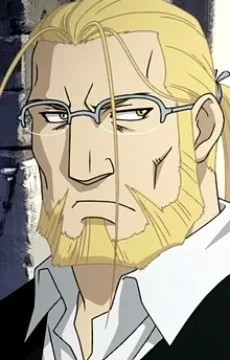
Van Hohenheim
Fullmetal AlchemistHe is the father of the protagonists, Edward and Alphonse Elric. He is a brilliant and well-known alchemist. He left Ed, Al, and their mother Trisha when Al was a baby and Ed was v
 SUPPORTING
Trisha Elric
Fullmetal AlchemistMother of Edward & Alphonse Elric. She dies of an unexplained illness when Ed and Al are around 7 or 8 years old.
 MAIN
MAINAlphonse Elric
Fullmetal AlchemistAlphonse Elric is a fictional character in the manga and anime series Fullmetal Alchemist. He is a human child who lost his body during a forbidden alchemical transmutation to brin
 SUPPORTING
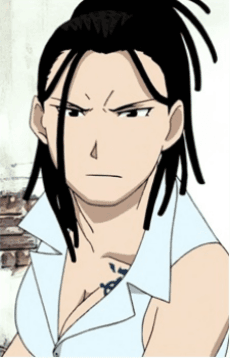
Izumi Curtis
Fullmetal AlchemistIzumi Curtis, born Izumi Harnet, the teacher of Ed and Alphonse Elric, agreed to train the brothers to hone their alchemical abilities after their mother died. She expands their tr
 SUPPORTING
Winry Rockbell
Fullmetal AlchemistA childhood friend of the central characters, the Elric brothers, she is often seen in their company throughout the series. She is evidently Edward's love interest. Specializing in
 SUPPORTING
Pinako Rockbell
Fullmetal AlchemistGrandmother of Winry, and old resident of Risembool. Also, a parent like figure to both Edward and Alphonse, after they lost their mother. It is shown that Pinako was Hohenheim
 SUPPORTING
Roy Mustang
Fullmetal AlchemistRoy Mustang is a state alchemist and officer in the Amestrian state military. A hero of the Ishval Civil War and Edward Elric’s superior officer, Mustang is a remarkably capable co
 SUPPORTING
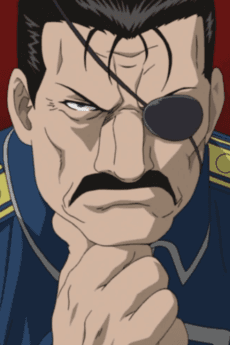
King Bradley
Fullmetal AlchemistKing Bradley is the Führer of the Amestris state military and has all state alchemist under his direct command. King Bradley almost always maintains a kind and calm demeanor even w
 SUPPORTING
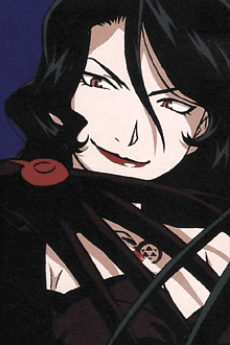
Lust
Fullmetal AlchemistLust is a Homunculus, nicknamed the "Ultimate Spear", and one of the first antagonists in the Fullmetal Alchemist series. She is the first Homunculus to appear in the ser
 SUPPORTING
Envy
Fullmetal AlchemistEnvy is a homunculus who has the ability to shapeshift. They use this power to assume the form of any person and even copy their voice. They usually serve as a spy, but their abili
 SUPPORTING
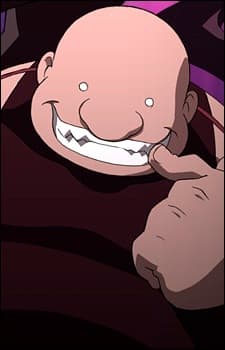
Gluttony
Fullmetal AlchemistGluttony is the second homunculus to appear in the series, typically being in the company of Lust. He is a large, simple-minded homunculus whose thoughts rarely stray far from eati
 SUPPORTING
Greed
Fullmetal AlchemistGreed is a greedy Homunculus, nicknamed the "Ultimate Shield". He is able to rearrange the carbon in his body to make his skin as hard as diamond, thus making himself alm
 SUPPORTING
Wrath
Fullmetal AlchemistWrath is the second youngest homunculi next to Sloth. He, like Pride, can age like a human. His ouroboros tattoo is located on the bottom of his left foot. Wrath is a special case
 SUPPORTING
Sloth
Fullmetal AlchemistSloth is the fifth Homunculus created by Father. Appearing as a giant, muscular, but mentally slow man, Sloth spends most of the story digging the country spanning underground tunn
 SUPPORTING
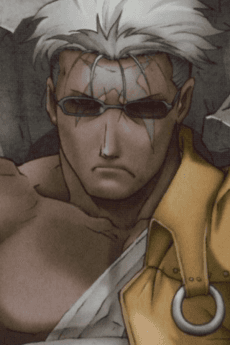
Scar
Fullmetal AlchemistScar is a disturbed loner. His right arm does not belong to him, but his brother. His brother was obsessed with finding the Philosopher's Stone and tattooed his whole body. During
 SUPPORTING
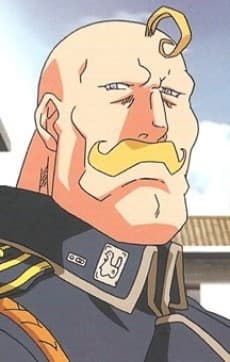
Alex Louis Armstrong
Fullmetal AlchemistMajor Alex Louis Armstrong, the Strong Arm Alchemist, was born into an elite family of alchemists and has mastered his family's techniques. Members of his family have, in the past,
 SUPPORTING
Riza Hawkeye
Fullmetal AlchemistRiza Hawkeye is Roy Mustang's most trusted subordinate. She carries out many of the tasks he is too lazy to do, acts as his personal assistant, and protects him from danger. She al
 SUPPORTING
Maes Hughes
Fullmetal AlchemistMaes Hughes is an Amestrian State Military officer stationed in the Investigations Office in Central City and Colonel Roy Mustang's best friend, as well as the closest supporter of