Appears In
Contents
Background
Background
Xin is orphaned by war while still young and grows up as a servant in a village in the state of Qin. His circumstances leave him with almost no social standing, education or realistic path into the aristocratic military establishment. He nevertheless becomes convinced that strength on the battlefield can provide an escape from the life assigned to him.
His childhood changes when he meets Piao, another orphan working under the same conditions. The two become inseparable training partners and make a shared promise to become Great Generals under the Heavens. With no formal instructor or proper weapons, they spend years fighting repeated practice matches with wooden swords, accumulating an enormous amount of practical experience against each other.
Piao's resemblance to Ying Zheng, the king of Qin, eventually draws the attention of the royal court. He is taken away from the village to serve as the king's double during a political crisis. Xin remains behind, frustrated that Piao has received an opportunity to enter the larger world first.
Piao later returns mortally wounded and leaves Xin instructions that bring him into contact with Ying Zheng himself. Piao dies from the injuries he received while serving as Zheng's double during Cheng Jiao's rebellion, leaving Xin to pursue the dream they had shared without him. That loss becomes one of the permanent foundations of Xin's ambition.
Xin initially has little respect for kings or court politics. His loyalty to Zheng grows through direct experience rather than ideology: he sees that the king is prepared to risk his own life, recognizes the scale of his goal and gradually decides that helping Zheng unify the states can coexist with his own ambition of becoming a Great General.
His participation in the struggle to retake the Qin capital gives Xin his first experience of warfare beyond childhood sparring. He fights beside Bi, Yang Duan He and the mountain people while Zheng works to defeat his younger brother's faction.
After the rebellion, Xin enters Qin's military as an ordinary infantryman. He receives no shortcut to command despite knowing the king personally. His rise instead depends on collecting achievements during campaigns, beginning a pattern in which enemy commanders become milestones on his route upward.
Personality
Personality
Xin is direct, loud and intensely competitive. He rarely conceals what he thinks and has little patience for the etiquette surrounding nobles, military families or court officials. His upbringing outside elite society leaves him largely unimpressed by inherited status.
His defining trait is persistence. Xin treats setbacks as temporary obstacles and often continues fighting long after ordinary soldiers would consider the situation lost. That refusal to yield allows him to inspire troops who would otherwise collapse under pressure.
He begins with an extremely simple understanding of military greatness. To the young Xin, becoming a Great General largely means becoming strong enough to defeat famous commanders and lead enormous armies. Experience gradually teaches him that command requires responsibility for thousands of lives rather than personal strength alone.
Xin possesses strong moral instincts even when he struggles to express them formally. He despises commanders who treat civilians or ordinary soldiers as disposable objects and reacts strongly to atrocities carried out under the excuse of warfare.
His lack of conventional education sometimes makes him appear unintelligent, particularly beside strategic specialists. Xin cannot initially read complicated battlefields the way trained tacticians can, and political discussions often leave him behind.
This limitation does not mean he lacks battlefield intelligence. Xin possesses exceptional instinctive awareness. In chaotic fighting he can feel shifts in momentum, recognize dangerous enemy movements and make decisions based on the atmosphere of a battlefield rather than formal calculations.
His relationships with soldiers also differ from rigid aristocratic command structures. Xin eats, argues and fights beside his men, and many members of the Fei Xin Force follow him because they have personally watched him risk himself alongside ordinary infantry.
He has difficulty processing romantic attention and often treats emotionally charged conversations with the same straightforwardness he brings to combat. His relationships with Qiang Lei and He Liao Diao therefore develop much more slowly than his military partnerships.
Appearance
Appearance

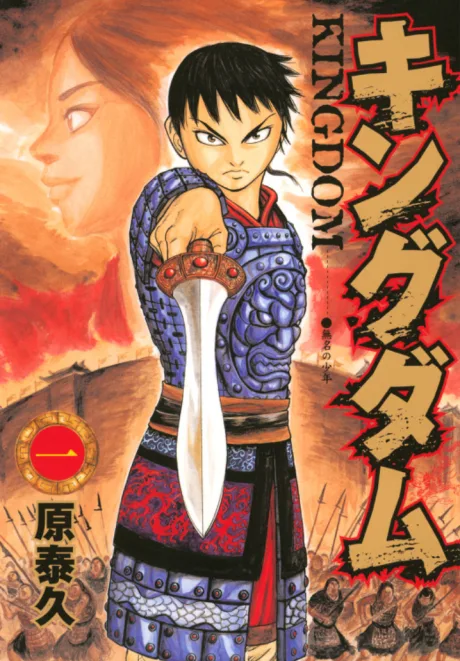
Xin begins the story as a small, wiry boy dressed in simple servant clothing. Years of constant training have already given him an athletic body, but he lacks the imposing size associated with established generals.
His hair is black and usually worn short and untidy. His expressions are highly animated, shifting quickly between anger, excitement and determination rather than maintaining the composed demeanor common among senior commanders.
As his military career progresses, Xin grows significantly taller and more muscular. Later official reference material places him at approximately 182 cm, reflecting the physical maturation that occurs over the many years covered by the story.
His early battlefield clothing remains comparatively simple. Even after gaining rank, Xin tends to retain practical armor rather than adopting highly ornamental equipment immediately.
One of his most important visual changes comes through his weapons. Xin begins with ordinary swords and gradually encounters weapons carrying enormous symbolic significance from previous generations of Qin warriors.
After inheriting Wang Qi's glaive, Xin eventually becomes capable of wielding the enormous weapon effectively in battle. The glaive visually marks his progression from an ambitious young soldier into someone carrying the legacy of one of Qin's Six Great Generals.
His later appearance increasingly resembles that of a full general: stronger armor, mounted command and the enormous glaive distinguish him from the servant boy shown at the beginning of the series.
Abilities & Powers
Abilities & Powers
Xin possesses no supernatural power in the conventional fantasy sense. His abilities come from extraordinary physical conditioning, combat experience, instinct and the accumulated weight of years spent fighting elite warriors.
His raw strength becomes exceptional even among Qin officers. Xin can overpower heavily armored soldiers, clash with enormous polearms and continue fighting after injuries that would incapacitate less conditioned troops.
His endurance is one of his defining strengths. Major battles in Kingdom often continue for days, forcing commanders to fight while sleep-deprived, hungry and wounded. Xin repeatedly remains operational under these conditions.
Swordsmanship forms the foundation of his early combat style. Years of practice against Piao give him an unusually large number of childhood sparring matches, and battlefield experience converts those habits into lethal technique.
Xin later adopts the glaive as his primary heavy weapon. The transition is difficult because the weapon demands substantially different strength, reach and timing from a sword.
Wang Qi's glaive initially proves too heavy for Xin to use at full effectiveness, but repeated campaigns gradually allow him to integrate it into his fighting style. Its increasing effectiveness parallels his growth as a general.
Xin is especially dangerous in single combat against enemy commanders. Kingdom's battles frequently treat the defeat of a general as both tactical and psychological, and Xin repeatedly seeks the strongest enemy officer because killing that figure can collapse opposing morale.
His greatest nonphysical ability is instinctive command. Xin does not process warfare primarily through conventional strategy. Instead, he increasingly develops the ability to sense where a battlefield is becoming dangerous or where an opportunity is about to emerge.
This instinctive approach allows him to function against commanders whose plans might otherwise overwhelm a less formally educated officer. Rather than calculating every formation several steps in advance, Xin identifies the emotional and tactical "fires" created by troop movement.
His charisma also grows into a genuine command asset. Xin's soldiers know that he will personally enter the most dangerous part of a battle, which gives his orders unusual motivational force.
Named Techniques
Named Techniques
Xin does not use a large catalog of formally named martial techniques. His most recognizable combat methods are defined by weapons, instinct and battlefield applications.
Sword Combat is the foundation of his early fighting style. Xin uses aggressive close-range attacks built from years of repeated sparring and real warfare rather than aristocratic fencing instruction.
Glaive Combat becomes increasingly important after he begins carrying the legacy weapon associated with Wang Qi. The glaive gives him greater reach and striking power against cavalry and heavily armored opponents.
Mounted Charge places Xin at the front of a cavalry assault, using personal momentum to break the enemy line while the Fei Xin Force follows behind him.
Commander Duel is a recurring battlefield role rather than an officially named technique. Xin deliberately challenges prominent enemy officers because their defeat can transform the morale of both armies.
Instinctive Battlefield Reading allows him to recognize decisive points without relying entirely on formal strategic analysis. The ability develops gradually as Xin encounters commanders whose warfare is built around instinct rather than calculation.
Unit Rally reflects his ability to restore morale through direct participation. Xin frequently turns exhausted soldiers back toward the enemy by personally taking the most dangerous position.
Relationships
Relationships
Piao is the person who gives Xin's childhood ambition its lasting form. Xin Li and Piao grow up together as war orphans and servants, repeatedly fighting practice matches while promising that both will someday become Great Generals under the Heavens.
[Piao's death leaves Xin Li carrying their shared dream alone. Xin continues speaking of becoming a Great General not merely as personal ambition but as the future the two boys intended to reach together.](#spoiler)
Ying Zheng begins as someone Xin approaches largely because of Piao's final request. Xin Li initially speaks to Ying Zheng with little respect for royal etiquette and openly resents the circumstances that caused Piao's death.
Their relationship changes during the struggle against Cheng Jiao. Xin sees Zheng personally risk himself to reclaim the throne and begins taking seriously his plan to unify the seven states.
Xin Li and Ying Zheng eventually develop a partnership based on parallel ambitions: Zheng intends to become the king who unifies China, while Xin intends to become the Great General capable of making that conquest possible.
Qiang Lei becomes one of Xin's most important comrades after initially joining his early military unit as a mysterious and exceptionally dangerous fighter. Qiang Lei's assassination techniques and tactical ability make her unlike the inexperienced infantrymen surrounding Xin.
Their trust develops through repeated campaigns. Qiang Lei becomes one of the pillars of the Fei Xin Force, while Xin increasingly treats her as someone whose ambitions matter independently of his own.
Their relationship develops explicit romantic undertones in later manga material, with both becoming increasingly aware that their bond extends beyond ordinary commander-and-officer loyalty.
He Liao Diao meets Xin during the rebellion surrounding Zheng and later becomes central to his military development. He Liao Diao eventually studies strategy so that she can contribute directly to Xin's rise rather than remaining someone protected by stronger fighters.
As strategist of the Fei Xin Force, He Liao Diao compensates for one of Xin's most obvious weaknesses. Xin supplies instinct, leadership and combat power; Diao provides detailed formations, logistics and strategic planning.
Wang Qi becomes one of Xin's most important models of what a Great General can be. Xin Li initially encounters Wang Qi as an almost incomprehensibly powerful veteran whose motives are difficult to read.
Wang Qi gradually recognizes Xin's potential and exposes him to the scale at which true generals perceive battle. Before dying after the Battle of Bayou, Wang Qi entrusts Xin with his glaive, making the weapon one of the clearest symbols of the older general's influence on him.
Biao Gong provides another model of generalship. Unlike strategists who dominate through careful formations, Biao Gong fights through instinct and an ability to feel where the decisive point of a battle will emerge.
Xin's exposure to Biao Gong becomes especially important because it helps explain his own command style. Biao Gong's death during the Coalition invasion leaves Xin another personal inheritance from the generation of generals he admires.
Wang Ben is one of Xin's principal military rivals. Wang Ben comes from the prestigious Wang family and receives elite training unavailable to Xin, making their competition a direct contrast between inherited military privilege and battlefield advancement.
The rivalry is frequently hostile, but both recognize the other's ability. As their ranks rise, Xin Li, Wang Ben and Meng Tian become identified as the leading commanders of Qin's younger generation.
Meng Tian approaches Xin with more friendliness than Wang Ben does. Meng Tian's intelligence, cavalry skill and relaxed personality make him an important peer, while his aristocratic background gives him access to military education Xin never received.
Bi is one of the earliest Qin officers to fight alongside Xin. Bi witnesses the servant boy's involvement in Zheng's restoration and later encounters him repeatedly as both rise through Qin's military.
Yang Duan He fights beside Xin during the struggle to restore Zheng. Yang Duan He's mountain forces expose him early to armies and cultures beyond the conventional Qin military.
Qiang Ming becomes connected to Xin through Qiang Lei's complicated history. Xin Li's involvement with the Qiang clan's affairs reinforces how deeply Qiang Lei's life has become tied to the Fei Xin Force.
Lü Buwei stands opposite Zheng in Qin's internal political struggle. Xin Li has little interest in court maneuvering compared with battlefield campaigns, but Lü Buwei's challenge to Zheng threatens the political cause that gives Xin's military ambition larger purpose.
Li Mu becomes one of Qin's greatest strategic obstacles. Xin Li first encounters Li Mu as an enemy whose plans operate on a scale far beyond the young soldier's understanding.
Repeated wars against Zhao transform Li Mu into both an enemy and a benchmark. For Xin and the younger Qin commanders, overcoming a strategist of Li Mu's stature becomes part of proving that they can eventually stand among China's greatest generals.
Pang Nuan represents a different kind of enemy. His overwhelming martial strength repeatedly brings him into collision with figures important to Xin's development.
Xin's later confrontation with Pang Nuan becomes one of the most important personal battles of his career, connecting memories of Wang Qi, Biao Gong and other fallen soldiers to the question of what gives a general's strength meaning.
Story Role
Story Role
Xin is the central viewpoint through which the military transformation of Qin is experienced. The story begins at the lowest possible level of society: an orphan without a family name, land or rank imagining himself at the summit of the military hierarchy.
His involvement with Zheng introduces the political objective that gives the series its larger direction. Xin's dream and Zheng's dream become mutually dependent: a king attempting unification needs generals capable of winning unprecedented wars, while Xin needs those wars to provide the achievements required for his own rise.
The early Qin rebellion establishes Xin as a fighter capable of changing events despite possessing no formal rank. His transition into the army then removes the exceptional circumstances of palace conflict and forces him to succeed within the military hierarchy.
The first campaigns emphasize how little he knows. Xin can defeat individual soldiers but initially has limited understanding of formations, logistics or command. The gradual growth of the Fei Xin Force allows the story to scale upward with him.
Wang Qi's involvement provides Xin with his first sustained look at generalship from the highest level. The difference between a strong warrior and a Great General becomes increasingly clear.
Wang Qi's death at Bayou turns that lesson into personal inheritance. Xin receives the general's glaive and carries the expectation that a younger generation will eventually surpass the old one.
The Coalition invasion greatly expands Xin's responsibilities. Qin faces an existential threat from multiple states, and battlefield achievements during the campaign establish that he is no longer merely an unusually talented junior officer.
Subsequent campaigns place the three young commanders—Xin, Wang Ben and Meng Tian—under increasingly demanding generals. Their competition becomes part of Qin's attempt to create the commanders required for eventual unification.
Season 6 of the anime, which aired in late 2025, reached the major Zhao campaign in which Xin, Wang Ben and Meng Tian are increasingly treated as central pieces of Qin's invasion force; a continuation was announced after the season concluded.
Later manga material advances Xin beyond command of a temporary independent unit and formally places him among Qin's generals. His adoption of the family name Li/Ri marks another stage in the transformation from nameless servant to recognized military figure.
Campaigns beyond the material covered by the sixth anime season continue testing whether Xin can function not merely as the warrior who kills an opposing general but as the commander responsible for an entire army's survival.
Character Development
Character Development
Xin's earliest idea of greatness is almost entirely personal. He wants a famous name, enormous strength and victories large enough to pull him out of the social position into which he was born.
Piao's death changes the emotional meaning of that ambition without changing its direction. Becoming a Great General becomes both Xin's dream and the continuation of a promise made to someone who can no longer pursue it.
Zheng expands the dream again. Xin gradually realizes that the greatest military achievements available to him will occur through Qin's attempt to unify China, connecting personal advancement with an historical undertaking far larger than either boy imagined during childhood.
Military experience teaches him the cost hidden inside heroic ambition. Soldiers die because commanders make decisions, and winning can require choices that have little resemblance to the glorious duels Xin once imagined.
Wang Qi and Biao Gong provide contrasting lessons. Wang Qi demonstrates broad command presence and the accumulated weight of experience; Biao Gong shows that instinct can operate at the level of entire armies rather than only personal combat.
The creation of the Fei Xin Force forces Xin to become responsible for specific people. Soldiers such as Wei Ping, Wei Dao, Long Chuan and others are not anonymous pieces to him. Their survival and deaths directly affect how he understands command.
He also learns to rely on expertise he does not possess. Accepting He Liao Diao as strategist is particularly important because Xin's pride could easily have pushed him toward pretending he could control every tactical detail himself.
Qiang Lei similarly prevents his leadership from becoming entirely centralized. Her strength and judgment allow the force to function through multiple capable officers rather than depending on Xin for every decision.
His rivalry with Wang Ben matures alongside him. Early competition focuses heavily on kills, promotions and pride; later campaigns increasingly measure them by whether they can make decisions worthy of generals.
Receiving the name Li Xin/Ri Shin formalizes a transformation that has been underway since the first chapter. The orphan who once possessed only the single name Shin gains a family name as his position within Qin society becomes permanent.
His later promotion to general does not complete his ambition. The title he has pursued from childhood is Great General under the Heavens, meaning each promotion merely expands the scale of the responsibility he must learn to carry.
Etymology
Etymology
Xin Li is the Chinese-order rendering of Li Xin (李信), the historical Qin general on whom the protagonist is based. In Japanese, the same characters are read Ri Shin, while the character is usually called simply Shin through much of the manga.
The given name Xin is written 信, a character associated with trust, faith, sincerity or confidence. The surname Li is written 李, literally referring to a plum and serving as one of the most common Chinese family names.
The use of a historically attested name reflects Kingdom's unusual relationship with history. Yasuhisa Hara uses real figures and campaigns from the Warring States period while inventing extensive personalities, relationships and battlefield details around the limited surviving record.
The historical Li Xin appears in sources concerning Qin's wars of unification. Hara's protagonist therefore exists as a fictionalized interpretation rather than a biographical reconstruction of the historical general.
For much of the manga, the protagonist is simply Xin/Shin because he begins as an orphan without an established family name. The eventual importance of "Li Xin" therefore carries social as well as historical significance.
Trivia
Trivia
-
Xin is based on the historical Qin general Li Xin, whose name is written with the same characters used for the manga protagonist.
-
He begins the story as a war orphan and servant, placing him far below the noble military families that produce rivals such as Wang Ben and Meng Tian.
-
Xin and Piao reportedly fight well over a thousand childhood practice bouts, giving both considerable sword experience before entering real warfare.
-
Masakazu Morita voices Xin in the Japanese television anime. Cole Howard is credited as his English voice.
-
The Fei Xin Force receives its name through Wang Qi, connecting Xin's independent unit directly to one of the generals he admires most.
-
His combat development moves from primarily sword-based fighting toward mastery of a large glaive associated with Wang Qi.
-
Xin placed third in the first major Kingdom character popularity election.
-
Official guidebook-derived profiles place later Xin at approximately 182 cm, with his age advancing substantially as the manga's historical timeline progresses.
In Other Media
In Other Media
Xin is the principal protagonist of the television anime adaptation of Kingdom. Masakazu Morita has voiced him in Japanese from the beginning of the series, carrying the role across the production changes separating the early seasons from the later Studio Signpost/Pierrot installments.
The anime follows his rise from war orphan through successive Qin campaigns. The first two seasons adapt his earliest military development, while later seasons expand into the Coalition War, Qin's internal political struggles and increasingly large invasions.
By the sixth season, broadcast from October through December 2025, Xin is operating alongside Wang Ben and Meng Tian in a campaign against Zhao on a scale far beyond his earliest infantry battles. The official anime site describes him as a boy who has repeatedly distinguished himself on battlefields while climbing toward the rank of Great General.
A continuation of the sixth television season was announced after its finale, so additional portions of Xin's manga career are scheduled for animation even though a premiere date was not initially provided.
Xin is also the protagonist of the live-action Kingdom film series, where he is played by Kento Yamazaki. The films reinterpret the early manga through live-action performances while preserving the central partnership between Xin and Zheng.
The first Kingdom film was released in 2019, followed by Kingdom 2: Far and Away in 2022, Kingdom 3: The Flame of Destiny in 2023 and Kingdom 4: Return of the Great General in 2024.
The live-action adaptations emphasize Xin's physical growth from inexperienced youth to battlefield warrior while condensing and restructuring portions of the manga to fit feature-length narratives.
Xin has additionally appeared in Kingdom mobile games and crossover promotions, generally represented as the sword- or glaive-wielding leader of the Fei Xin Force.
Reception
Reception
Xin occupies the central position in a franchise that has grown into one of Japan's largest historical manga successes. Kingdom surpassed 120 million copies in circulation by January 2026, and the series has received both major sales success and the Tezuka Osamu Cultural Prize Grand Prize.
His appeal is closely connected to the scale of his progression. The narrative does not introduce him as a secretly established prince, noble heir or trained officer. He begins without a surname, military education or social standing and has to accumulate rank through visible battlefield achievements.
The partnership with Zheng gives that progression historical direction. Xin's dream could otherwise remain a generic desire for fame; connecting it to Qin's unification campaign turns every promotion into part of a larger transformation of the Warring States world.
His rivalry with Wang Ben and Meng Tian reinforces the class dimension of his rise. Both competitors come from powerful military families and receive advantages Xin never possessed, forcing him to prove that experience, leadership and individual achievement can overcome pedigree.
Xin's fighting style has also remained deliberately physical despite the extraordinary scale of later battles. Kingdom exaggerates the strength and presence of famous warriors, but Xin's advancement is still framed primarily as accumulated training, experience and command rather than a sudden supernatural power system.
The first major official Kingdom popularity election placed Xin third, demonstrating that even as the protagonist he competes for reader attention with a very large ensemble of generals, strategists and political figures.
His relationship with historical Li Xin adds another layer to reception. Readers familiar with the Qin wars know that the protagonist is moving toward campaigns recorded in ancient Chinese histories, creating tension between the fictional personality developed over hundreds of chapters and the limited historical outcomes associated with his namesake.
Later manga material increasingly tests whether Xin's early definition of a Great General can survive the realities of high command. Personal courage remains essential, but victories now depend on logistics, subordinate commanders, strategic judgment and decisions in which thousands of lives may hinge on a single order.
That progression keeps the original promise with Piao relevant even after Xin has already achieved ranks the two boys once considered unimaginable. The central question is no longer whether a servant can enter the military hierarchy, but whether the man he becomes can carry enough responsibility to deserve the title he has pursued since childhood.
Related Characters
 SUPPORTING
Piao
KingdomHe grew up as a slave together with his best friend and fellow orphan, Xin. When Xin first arrives at the village head's home, Piao befriends him and gives him the dream of becomin
 SUPPORTING
Biao Gong
KingdomBiao Gong is a Great General from the state of Qin who led an invading Qin army to besiege the Wei city of Keiyou. He is known for being an instinctive general for his use of crude