Appears In
Quick Facts
| Gender | Female |
| Role | SUPPORTING |
| Series | Demon Slayer: Kimetsu no Yaiba |
| Gender | Female |
| Species | Demon |
| Eye Color | Lime green with orange centers |
| Hair Color | Black while disguised; white with lime-green tips in combat |
| Voice Actor (JP) | Miyuki Sawashiro |
| Voice Actor (EN) | Erica Lindbeck |
| Affiliation | Twelve Kizuki |
| Rank | Upper Rank Six |
| Aliases | Ume; Warabihime Oiran; Upper Six |
| Brother | |
| Creator | |
| Master | |
| Manga Debut | Chapter 73, “Chasing” |
| Anime Debut | Episode 34, “Infiltrating the Entertainment District” |
Contents
1.Profile3
2.Abilities2
Background
Background
Daki was born human under the name Ume in Rashomon Riverbank, the poorest area of Yoshiwara’s Entertainment District. Her mother suffered from illness and severe mental instability, leaving Ume dependent on her older brother Gyutaro. Her exceptional beauty contrasted sharply with the deprivation surrounding them and eventually allowed her to work within the district while Gyutaro collected debts.
Gyutaro protected and took pride in his younger sister, regarding her beauty as compensation for the appearance and poverty that made him an object of contempt. Ume, in turn, relied completely upon him. At thirteen, she stabbed a samurai in the eye with a hairpin after he insulted Gyutaro. In retaliation, she was bound and burned alive, then abandoned in a ditch.
Gyutaro found her barely alive and killed the people responsible. While carrying her through the district, he encountered Doma, who was then Upper Rank Six. Doma offered both siblings his blood and encouraged them to survive the transformation into demons. Their shared desperation and refusal to die separated made them an unusual paired demon.
After becoming Daki, Ume remained in Yoshiwara and repeatedly assumed new identities. Her behavior eventually exposed each persona, forcing her and Gyutaro to move between houses as districts burned or collapsed around them. Daki’s names traditionally contained the Japanese character for “princess,” reflecting both her beauty and the superior status she demanded from others.
By the Taishō era, she operates as Warabihime Oiran of the Kyogoku House. She abducts residents and visitors who attract her interest, preserving them as food within her obi rather than consuming every victim immediately. Her disappearances are concealed by the authority, wealth, and fear surrounding her public identity.
Personality
Personality
Daki is vain, domineering, and violently intolerant of perceived ugliness. She divides people according to appearance and usefulness, treating beautiful humans as desirable food and dismissing others as unworthy. Her status as an oiran reinforces this attitude because attendants, clients, and house managers are expected to accommodate her demands.
She governs through fear. Employees who disappoint her are verbally humiliated, physically abused, or threatened with death. Although capable of maintaining a refined public persona, she abandons it quickly when challenged. Her temper repeatedly jeopardizes the discretion necessary to preserve an identity within Yoshiwara.
Daki believes strength and beauty entitle her to superiority. She initially dismisses young Demon Slayers as weak and becomes enraged when a human resists her attacks. Praise from Muzan has inflated her confidence, although his private assessment is considerably less favorable: he regards her as a means of controlling Gyutaro and considers her less capable than she believes.
Under severe pressure, Daki’s adult composure collapses into childish distress. She cries, throws tantrums, and immediately calls for Gyutaro when humiliated or injured. This behavior reflects the age at which she became a demon and the dependence that shaped her human life. Her cruelty is genuine, but so is her inability to function emotionally without her brother.
She is especially sensitive to comparisons involving beauty. Nezuko Kamado’s transformed appearance provokes jealousy, while memories of human suffering can briefly disrupt Daki’s confidence. Her reactions suggest that the oiran identity is not merely camouflage; it is a structure through which she proves that Ume, once treated as disposable, now stands above everyone around her.
Appearance
Appearance
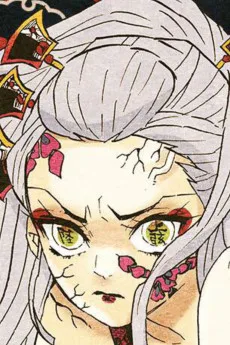
As Warabihime Oiran, Daki appears as a tall, pale woman with long black hair arranged in an elaborate ponytail. Kanzashi ornaments and a golden comb secure the hairstyle, while traditional cosmetics emphasize her lips and eyes. Her layered kimono, elevated geta, and formal bearing establish her as one of the district’s highest-ranking courtesans.
Her eyes reveal her place among the Twelve Kizuki when exposed. The kanji for “Upper Rank” appears in her left eye, while the formal numeral for six appears in her right. She has lime-green irises with orange centers, long eyelashes, pointed nails, and exceptionally pale skin.
When she abandons her disguise and absorbs her detached obi, her hair becomes white with lime-green ends. Flower-like demon markings appear across her face, and the number and shape of her sashes become more prominent. Her clothing shifts toward a revealing patterned outfit constructed around the obi that functions as both garment and weapon.
After Gyutaro emerges, Daki develops a third eye on her forehead. This eye resembles her brother’s and permits him to share her vision, improve her responses, and coordinate attacks from a separate location. The physical change makes their linked nature visible even while they occupy different bodies.
Her human appearance as Ume closely resembles her transformed state. She had pale hair and striking eyes, and her beauty was considered remarkable even within Yoshiwara. That appearance shaped both the opportunities available to her and Gyutaro’s belief that she possessed the social value he lacked.
Abilities & Powers
Abilities & Powers
Daki possesses the enhanced strength, speed, endurance, and sensory abilities common to powerful demons. She can tear through buildings with her sashes, react to attacks from trained Demon Slayers, and continue fighting after injuries that would instantly kill a human. Muzan’s blood and more than a century of feeding place her far beyond ordinary demons.
Her regeneration repairs severed limbs and extensive damage rapidly. Her neck can alter its composition to become flexible like an obi, reducing the effectiveness of a Nichirin blade. This adaptation allows her to resist decapitation attempts that would succeed against demons with rigid anatomy.
Daki’s most important defensive advantage comes from her shared existence with Gyutaro. Removing only her head does not kill the pair. They must be decapitated simultaneously before either can recover, a condition that conceals the true difficulty of defeating Upper Six. This allows Daki to survive apparent defeats long enough for Gyutaro to intervene.
Her fighting style centers on distance and area control. Daki sends multiple sashes across streets and buildings, attacking from angles that force opponents to divide their attention. The sashes can bend around sword strikes, form shields, carry her through the air, or intersect into cutting patterns with few safe openings.
She has consumed many humans and claims to have killed seven Hashira. Gyutaro has killed a further fifteen, giving the siblings a long record of victories over the Demon Slayer Corps. Daki’s personal combat ability is lower than Gyutaro’s, but her range and ability to divide the battlefield make her essential to their combined fighting style.
Obi Sash Manipulation
Obi Sash Manipulation
Daki’s Blood Demon Art creates patterned obi sashes from her flesh. They are soft and flexible like silk but possess edges sharp enough to cut buildings and clash with Nichirin swords. She can produce them from her back, retract them into her body, or control them over long distances.
Their flexibility makes them difficult to sever. Instead of meeting a sword as a rigid surface, an obi can bend around the blade, absorb part of the impact, and continue moving from another angle. Daki uses this property to attack and defend simultaneously.
She may convert her neck into a sash-like structure as an extension of the same bodily control. The loosened tissue makes a clean decapitation harder because the blade cannot apply force against a stable target.
Detached Obi
Detached Obi
Daki can separate portions of her sash from her main body and give them limited independent awareness. One such obi operates beneath Yoshiwara, capturing people and storing them inside an underground chamber while Daki maintains her Warabihime identity above ground.
The detached obi can communicate, assess threats, and fight without Daki’s direct physical presence. It restrains multiple trained opponents and kunoichi at once, demonstrating strength well beyond an ordinary extension of clothing.
When Daki reabsorbs the sash, she recovers the power and victims stored within it. The reintegration strengthens her scent, presence, and combat ability, returning divided portions of her flesh to a single body.
Human Storage
Human Storage
Daki can flatten captured humans inside her obi without immediately killing them. Their bodies remain embedded like designs in the fabric, allowing her to transport and preserve a large supply of food discreetly.
Cutting the correct areas of the sash can release the captives, but careless attacks risk injuring them. This forces Demon Slayers to balance destroying the obi against protecting the people trapped within it.
Named Techniques
Named Techniques
- Eight-Layered Obi Slash: Daki launches eight broad sashes in an interwoven pattern from multiple directions. She describes the formation as having no blind spots, forcing its target to evade or counter several flexible blades simultaneously.
- Obi Sash Manipulation: The general form of Daki’s Blood Demon Art, through which she creates, extends, reshapes, and remotely controls living obi made from her flesh.
- Shared Vision: A combined ability used with Gyutaro rather than a formally announced attack. The eye on Daki’s forehead transmits her field of view to her brother and enables coordinated two-front combat.
Several additional named attacks associated with Daki originate in licensed games rather than the original manga. They expand the applications of her obi but are not all separately named canonical techniques in the source story.
Gyutaro
Gyutaro
Gyutaro is Daki’s older brother, protector, and the other holder of the Upper Six title. He raised her amid the poverty and violence of Rashomon Riverbank, taking pride in the beauty that distinguished her from the people who scorned him. Daki depended on him for survival long before either became a demon.
Their demon abilities preserve that dependence physically. Gyutaro normally remains concealed within Daki’s body and emerges when she is threatened. His presence explains why decapitating her alone is insufficient, while his shared eye improves her reactions during battle.
Daki treats Gyutaro differently from everyone else. She insults him during moments of anger and blames him when frightened, yet instinctively calls for him whenever she cannot cope. He tolerates her tantrums, attacks anyone who harms her, and remains driven by the belief that his sister deserves advantages denied to him.
After both are defeated, Daki reverts emotionally to Ume and argues with Gyutaro in the afterlife. When he tries to send her toward the light without him, she refuses, recalls their childhood promise never to separate, and follows him into the darkness.
Muzan Kibutsuji
Muzan Kibutsuji
Muzan Kibutsuji is Daki’s master and the progenitor whose blood ultimately sustains her position among the Twelve Kizuki. Daki is eager for his approval and responds to his presence with fear, admiration, and visible pleasure.
Muzan Kibutsuji flatters Daki by calling her a special demon and praising her beauty and cruelty. She interprets these remarks as confirmation that she deserves the Upper Rank title.
His private view is more calculating. Muzan Kibutsuji considers Daki unintelligent and recognizes that she weakens Gyutaro in direct combat. He nevertheless indulges her because controlling and encouraging her provides leverage over the more dangerous sibling.
Doma
Doma
Doma discovers Gyutaro carrying the burned and dying Ume through Yoshiwara. At the time, he holds the position of Upper Rank Six and offers both siblings his blood, leaving their survival to Muzan’s acceptance.
Daki therefore owes her demonic existence to Doma, although the story does not depict a close ongoing relationship between them. His intervention is casual from his perspective but decisive for the siblings, transforming a shared human tragedy into more than a century of predation.
Doma’s subsequent promotion allows Gyutaro and Daki to inherit the Upper Six position. Their transformation also reflects his habit of treating suffering humans as potential amusements or converts rather than approaching them with compassion.
Tanjiro Kamado
Tanjiro Kamado
Tanjiro Kamado identifies Daki as the demon hidden within Yoshiwara and confronts her after she attacks civilians. Daki initially considers him beneath her notice because he is not a Hashira.
His resistance unsettles her. Tanjiro Kamado’s anger over the lives she has taken pushes his Hinokami Kagura beyond its usual limits, allowing him to cut through her sashes and nearly reach her neck.
Daki responds by widening her attacks without concern for surrounding residents. Tanjiro Kamado’s determination to protect strangers directly opposes her belief that weak or unattractive humans have no value.
Nezuko Kamado
Nezuko Kamado
Nezuko Kamado intervenes when Tanjiro reaches his physical limit. Her rapidly developed combat form overwhelms Daki in close quarters and regenerates from sash wounds faster than Daki expects.
Daki becomes jealous of Nezuko Kamado’s appearance and strength. She is especially shocked that another female demon can injure her despite lacking membership in the Twelve Kizuki.
Nezuko Kamado’s Blood Demon Art burns demons without harming humans, providing a direct counter to Daki’s regeneration and severing attacks. Their battle ends when Tanjiro restrains Nezuko before she attacks nearby humans.
Tengen Uzui
Tengen Uzui
Tengen Uzui infiltrates Yoshiwara to investigate the disappearance of his wives and eventually identifies Daki’s role. Upon meeting her directly, he decapitates her with such speed that she initially fails to recognize what has happened.
His dismissal wounds Daki’s pride. Tengen Uzui states that she is too weak to be the true Upper Six, prompting her emotional collapse and Gyutaro’s emergence.
Once the siblings fight together, Daki uses her long-range sashes to interfere with Tengen Uzui’s battle against Gyutaro. His explosives and paired Nichirin cleavers can repel her attacks, but the need to decapitate both siblings simultaneously prevents him from concentrating on Gyutaro alone.
Zenitsu Agatsuma
Zenitsu Agatsuma
Zenitsu Agatsuma encounters Daki while disguised as an attendant at the Kyogoku House. He intervenes when she mistreats a young girl, prompting Daki to recognize his connection to the Demon Slayer Corps and abduct him.
Daki stores Zenitsu Agatsuma within her underground obi. After being freed, he joins the battle against her and uses Thunder Breathing to match the speed of her moving sashes.
Zenitsu Agatsuma becomes one of the principal fighters responsible for reaching Daki’s neck. His Godlike Speed creates the opening required for the simultaneous decapitation plan, although the technique severely strains his legs.
Inosuke Hashibira
Inosuke Hashibira
Inosuke Hashibira locates Daki’s underground food store by sensing the demon concealed within the Ogimoto House. He cuts into the burrow and attacks the detached obi while attempting to free its captives.
His flexible joints and unconventional Beast Breathing make Inosuke Hashibira difficult for the sash to predict. He later coordinates with Zenitsu against Daki’s main body.
During the decisive exchange, Inosuke Hashibira uses his serrated swords to complete the cut through Daki’s neck and carries her severed head away, preventing immediate reattachment.
Hinatsuru, Makio, and Suma
Hinatsuru, Makio, and Suma
Hinatsuru, Makio, and Suma infiltrate the district as Tengen’s kunoichi investigators. Daki identifies them as threats and uses her obi to capture Makio and Suma, while Hinatsuru poisons herself to escape direct control and send information.
Makio and Suma are held within the underground sash alongside other victims until Inosuke’s intervention. Once freed, they help protect the captives and resist the detached obi.
Hinatsuru’s wisteria-laced kunai primarily target Gyutaro, but their involvement forces Daki and her brother to divide attention across several coordinated opponents.
Story Role
Story Role
Daki is introduced through the disappearances and abuse surrounding Yoshiwara’s houses. Before her identity is openly revealed, the arc presents her as an unseen predator capable of moving through buildings and removing people without leaving conventional evidence.
Her Warabihime persona places the demon within the Entertainment District’s social hierarchy rather than outside it. She does not need to attack every victim in an alley; prestige gives her privacy, authority, and a population trained not to question her cruelty.
The confrontation with Tanjiro initially frames Daki as the holder of Upper Rank Six. Her ability to damage entire streets and withstand Hinokami Kagura establishes the gulf between the protagonists and the Twelve Kizuki after the Mugen Train mission.
Tengen’s effortless decapitation reveals that Daki alone does not account for Upper Six’s reputation. Gyutaro’s emergence reframes the battle around two linked demons who must be killed together, turning Daki’s apparent weakness into part of the pair’s unusual defense.
Her sashes keep Zenitsu, Inosuke, and multiple support fighters separated from the central duel. Daki is therefore not merely an accessory to Gyutaro: she controls the battlefield, protects his neck indirectly, and makes simultaneous decapitation extraordinarily difficult.
Character Development
Character Development
Daki begins the arc as a figure of absolute social and physical control. Within the Kyogoku House, no attendant can oppose Warabihime. As Upper Six, she assumes that a century without defeat proves her superiority over the Demon Slayers sent against her.
Tanjiro and Nezuko gradually dismantle that certainty. Tanjiro survives attacks she considers decisive, while Nezuko overwhelms her through strength and regeneration. The encounter exposes how much of Daki’s confidence depends on facing opponents who fear her or die before challenging her self-image.
Tengen’s arrival strips away the adult persona completely. Once decapitated and dismissed as too weak, Daki responds not as a composed oiran but as the injured thirteen-year-old who expects her brother to solve what she cannot. Gyutaro’s emergence restores her aggression without resolving that dependence.
Their defeat returns Daki to her human identity as Ume. She initially lashes out at Gyutaro, repeating the cruel language that defined their demonic lives, but rejects his effort to abandon her for her own sake. Her final choice is not power, beauty, or Muzan’s approval; it is remaining with the brother who protected her when they had nothing else.
Etymology
Etymology
The name Daki is written 堕姫. The first character can mean “fall” or “degenerate,” while the second means “princess,” producing a reading commonly interpreted as “fallen princess.” The construction matches the princess character that appears in several of her aliases.
Her human name, Ume, is written 梅, meaning “plum.” Gyutaro explains that she was named after the disease that killed their mother: bai or ume can be readings associated with the first character in the Japanese term for syphilis, baidoku.
Warabihime combines warabi, meaning “bracken,” with hime, meaning “princess.” The recurring princess suffix reflects Daki’s habit of selecting prestigious identities centered on her beauty and rank.
Trivia
Trivia
- Daki and Gyutaro jointly occupy one Upper Rank position rather than holding separate ranks.
- Daki claims to have killed seven Hashira, while Gyutaro killed fifteen.
- She became a demon after being burned alive at thirteen.
- Her detached obi can preserve living humans as two-dimensional patterns within its fabric.
- Muzan praises Daki directly but privately considers Gyutaro the more capable sibling.
- Her oiran identities repeatedly include a character meaning “princess.”
- Her third eye belongs to Gyutaro and enables shared vision during combat.
- Daki placed 40th in the second official character popularity poll with 180 votes.
In Other Media
In Other Media
Daki is a principal antagonist in the Entertainment District Arc of the television anime. Miyuki Sawashiro voices her in Japanese, while Erica Lindbeck performs the English dub. The adaptation expands the scale and movement of her obi attacks through extended sequences across Yoshiwara’s rooftops and streets.
She appears in the theatrical presentation Demon Slayer: Kimetsu no Yaiba – To the Swordsmith Village, which includes the final Entertainment District episodes before the Swordsmith Village premiere. Her role consists of material adapted from the television storyline rather than a separate film narrative.
Daki is playable in Demon Slayer: Kimetsu no Yaiba – The Hinokami Chronicles through post-release content. The game gives names to several obi attacks not individually named in the manga, including Obi Assault, Obi Pursuit, Piercing Obi, Entangling Obi, and Severing Obi.
The game also includes combined techniques with Gyutaro, such as Poison and Obi Cross Slash and Unshakeable Duo. These moves translate the siblings’ coordinated combat into paired cinematic attacks while remaining game-specific expansions.
Reception
Reception
Daki ranked 40th in the manga’s second official character popularity poll, receiving 180 votes. The result placed her among the recognized supporting antagonists despite the poll occurring within a series dominated by Demon Slayers and Hashira.
Her anime portrayal drew attention to the Entertainment District Arc’s shift in visual setting and scale. The contrast between Warabihime’s elaborate oiran presentation, Daki’s white-haired combat form, and Ume’s childhood appearance gives her several distinct visual identities used across promotional art and merchandise.
Daki and Gyutaro are frequently marketed as a pair, reflecting the mechanics and emotional history that define Upper Six. Figures, game rosters, and collaboration artwork commonly emphasize her obi patterns and his blood sickles as complementary designs.
Related Characters
 MAIN
MAINNezuko Kamado
Demon Slayer: Kimetsu no YaibaTransformed into a demon and left mute, Nezuko travels with her older brother Tanjirou in a box on his back. She can change her size at will, and is a capable fighter when she need
 SUPPORTING
Muzan Kibutsuji
Demon Slayer: Kimetsu no YaibaHe is the Demon King, the first of his kind, and the progenitor of all other demons in existence. Muzan is also the leader of the Twelve Kizuki, an organization of the twelve stron
 SUPPORTING
Doma
Demon Slayer: Kimetsu no Yaiba"Bohemian Knight" Doma is an infamous New World pirate who allied himself with Whitebeard. Doma has a beard that seems to have lines that extend to his eyes. He also wear
 SUPPORTING
Tengen Uzui
Demon Slayer: Kimetsu no YaibaA Demon Slayer, and the Sound Pillar of the Demon Slayer Corps. Tengen is a very eccentric person, always wanting to complete actions as flashy as possible. Although he has display
 MAIN
MAINZenitsu Agatsuma
Demon Slayer: Kimetsu no YaibaZenitsu Agatsuma is one of the main protagonists of Demon Slayer: Kimetsu no Yaiba and along with Inosuke Hashibira, a traveling companion of Tanjiro Kamado and Nezuko Kamado.
 MAIN
MAINInosuke Hashibira
Demon Slayer: Kimetsu no YaibaInosuke is usually seen wearing a grey boar mask, with a shirtless version of the Demon hunter uniform. Without the mask he has messy shoulder length black hair and large green eye
 SUPPORTING
Hinatsuru
Demon Slayer: Kimetsu no YaibaHinatsuru is a kunoichi and one of Tengen Uzui's wives.
 SUPPORTING
Makio
Demon Slayer: Kimetsu no YaibaMakio is a kunoichi and one of Tengen Uzui's wives.